

PVTIME – On May 28, 2026, CATL announced the official operation of the Xiamen Energy Storage Validation Research Institute (ESVL), the world’s largest and most comprehensive one-stop testing and validation platform for energy storage systems. Built around five innovative laboratories, ESVL is designed to support full-scenario validation and serve as open infrastructure for the global energy storage industry. Its launch marks the industry’s transition from specification-based claims to a new era of real-world validated energy storage.
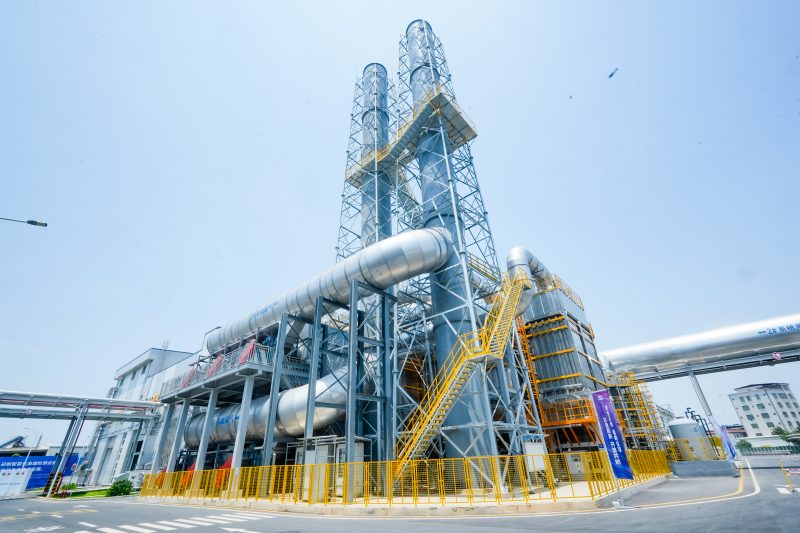
Real-world validated energy storage represents the development direction of the next generation of energy storage systems. Instead of relying solely on component-level parameters, it uses full-scale, station-level systems as the unit of verification, subjecting them to systematic testing under simulated real-grid, real-environment and real-operation conditions. This approach not only answers whether a system can function, but also verifies its long-term stability under complex grid conditions, reliability in extreme climates, lifecycle safety and effectiveness in supporting commercial revenue strategies. ESVL is the foundational facility designed to carry this model forward.
As the initiator and early practitioner of the real-world validated energy storage era, CATL remains committed to an open and collaborative approach. From the outset, ESVL has been established as a public platform open to the entire industry and is working with leading certification bodies including TÜV SÜD, TÜV Rheinland, CSA and China General Certification Center (CGC). CATL looks forward to working hand in hand with partners across the value chain to advance the industry from an era of claimed lifespan to one of validated lifespan, laying a solid and trustworthy quality foundation for the global energy transition.
Industry Challenge: From Rapid Growth to Sustainable Scale-Up
As a core enabling technology for global carbon neutrality, energy storage is moving from policy-driven growth toward market-oriented deployment. BloombergNEF forecasts that global new installed energy storage capacity will reach 158 GW in 2026, up 41% from 2025, underscoring a new phase of large-scale deployment in which economics, reliability and bankability are becoming central to investment decisions.
However, rapid growth in installed capacity has also brought three long-standing structural challenges into sharper focus.
- A critical gap in the validation system: The industry has evolved from component testing to scenario testing, but validation still stops short of station level. Cells, PCS and other individual components can be tested independently, and fire or high/low-temperature tests remain important, but they cannot reproduce the coupled behavior of a station-level system in real operation. As projects scale from megawatt-level assets to gigawatt-level infrastructure, the industry now urgently needs real-world validated energy storage — with systematic capabilities spanning the full chain from cell to battery pack, energy storage system and station — to verify station-level grid compatibility, safety boundaries and reliability under extreme operating conditions.
- High cost of global grid compatibility adaptation: Grid standards and operating conditions vary greatly across countries and regions. Energy storage products seeking global market entry often need to undergo repeated testing and certification in laboratories across multiple countries, with an average certification cycle of 7–15 months. This significantly raises costs of global business expansion and delays market entry opportunities.
- Asset credibility crisis: A persistent gap between advertised lifespan and actual service life remains one of the most visible challenges facing the energy storage industry. Power-type storage (for fast response scenarios) is typically marketed as having around a 10-year lifespan, while energy-type storage (for long‑duration energy delivery) is often positioned as a 20-year asset; in practice, many systems still fall well short of those expectations. As the industry scales, this issue is becoming more visible: nearly one in five large-scale energy storage power stations worldwide are underperforming, while 46.5% of energy storage systems experience grid-connection delays of more than two months.
As energy storage is increasingly deployed, financed and insured as a long-duration infrastructure asset, the gap between advertised lifespan and actual service life directly affects bankability. If real-world operating life cannot be reliably demonstrated, investors cannot build dependable financial models, insurers cannot price risk with confidence, and global customers cannot assess long-term value on a sound basis.
In response to these shared industry pain points, CATL invested in ESVL to build an open, authoritative, near real-world validation platform for energy storage. By providing traceable, verifiable and station-level validation data, ESVL gives global owners and regulators a stronger evidence base for procurement and decision-making, helps investors build more reliable financial models, supports financial institutions in making more precise credit assessments, and enables insurers to perform more scientific actuarial pricing. More importantly, it helps close the gap between claimed performance and real-world value, turning energy storage from a technology defined by assumptions into an asset defined by proof.
Five Core Laboratories Deliver Full-Scenario Validation for Global Energy Storage Assets
Through five core laboratory clusters, ESVL has built a real-world validated energy storage testing platform that supports full-scenario validation and station-level verification.
- Grid Integration Laboratory: The World’s First Station-Level Operational Validation Platform
Validation requirements for energy storage systems should originate from real grid application scenarios. Because power systems and grid-connection standards vary by country, a realistic grid environment is needed to verify grid performance.
The Grid Integration Laboratory at ESVL was built with reference to the design experience of the U.S. National Renewable Energy Laboratory (NREL). Its core setup consists of a real-time simulator and a grid simulator: the real-time simulator models different power systems and sends control commands to the grid simulator, while the grid simulator provides the grid interface and reproduces the voltage and current dynamics of real power systems. As a result, ESVL’s operating environment is fully aligned with real grids at engineering sites. The platform is rated at 35kV/100MVA, compared with NREL’s 13.8kV/7MVA platform, making it 14 times larger.
The laboratory can simulate multiple application scenarios, including zero-carbon microgrids and AI data center power supply. Before deployment to project sites, energy storage systems can complete comprehensive validation at both the unit and station levels, significantly improving commissioning safety and shortening commissioning cycles.
The world’s first station-level grid integration laboratory is built around a 35kV/100MVA grid simulator and a real-time simulator, creating a controllable grid testing platform that accurately reflects grid dynamics at engineering sites. It can conduct grid-related testing simultaneously on more than 10 large energy storage containers and reproduce all harsh grid conditions for domestic and international energy storage systems, enabling full-scenario validation.
With grid topology simulation of more than 1,000 nodes, the laboratory can reproduce grid structures equivalent to the complexity of a provincial transmission network. Each node corresponds to a real substation or grid-connection point. The grid simulator can also inject harmonic voltages from 1 to 2,500 Hz to test system performance under grid disturbances. The grid complexity addressed by ESVL is already at the same level as that of real project sites.
The laboratory covers a wide frequency range of 15 Hz to 60 Hz, meeting major domestic and international grid standards and supporting validation for global deployment scenarios, including large renewable energy bases, high-penetration renewable microgrids, islanded microgrids such as mining and oilfield sites, and AI data center power supply. Its voltage range covers 380V to 35kV, enabling simulation of power systems in different countries, such as France’s 20kV/50Hz distribution grid and U.S. 60Hz systems at 13.8kV or 34.5kV.
For station-level grid-forming capability validation, the focus is not simply whether a system can connect to the grid, but whether station-level grid-forming capability is actually established, whether multi-unit coordination remains stable, whether control strategies can be executed, and whether revenue strategies remain effective under real grid fluctuations. The laboratory can simulate extreme scenarios such as wide-band oscillation and weak-grid conditions (low inertia and high impedance). In terms of overload capability, with the combined support of a 25MW high-voltage energy storage system and the grid, six-times overload testing can be conducted, while current grid-forming standards require only three-times overload testing.
For station-level integration, the laboratory can parallel 10 to 20 devices at the same time to verify multi-unit coordination strategies. While national standards require only single-unit testing, ESVL recreates real station conditions and completes system-level debugging before shipment, avoiding situations where strategies are found not to work only after arriving at the project site.
- High-Voltage Safety Laboratory: Revealing the Root Causes of Failure
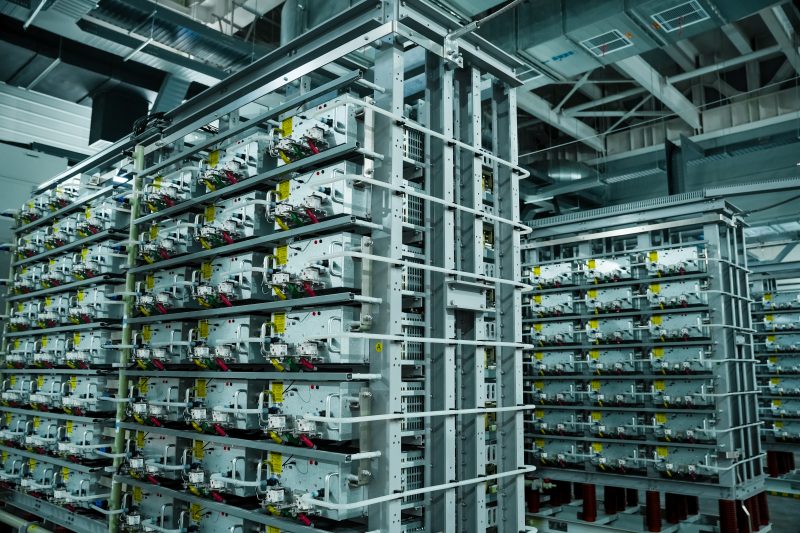
Current industry practice still includes high-voltage laboratories that do not carry out high-voltage testing on energy storage systems, leaving anti-breakdown capability unknown and creating significant hidden risks. Abnormal events such as lightning strikes and grid oscillation disturbances can generate extremely high overvoltage in an instant, potentially breaching equipment insulation and triggering thermal runaway or even fire. This is why ESVL conducts tests such as lightning impulse, power-frequency and DC withstand voltage, and partial discharge testing.
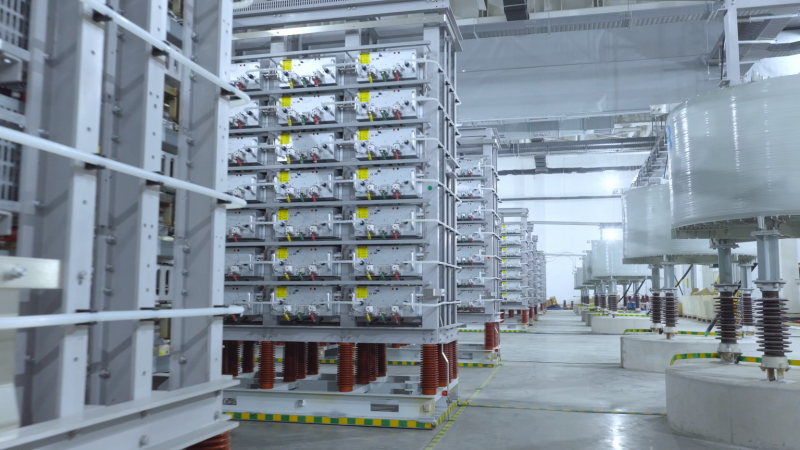
Covering a wide testing range from 1kV to 500kV, the laboratory can analyze the safety boundaries of key components and full systems under extreme conditions such as lightning strikes, switching impulses and high-current surges, identify the real mechanisms behind fire and explosion, and guide equipment design from the root cause toward preventing fire and explosion.
- Thermal Safety and Combustion Laboratory: Controlled Fire Validation at Scale
Combustion testing is the last line of defense for verifying equipment safety and an important way to assess safety spacing between containers. Compared with simulation, real combustion tests often reveal many unanticipated issues. For example, after insulation burns through and creates new short circuits, components that were originally intended to protect the equipment may instead become the trigger for cascading fire, adding more combustion energy and allowing local burning to develop into a station-level disaster.
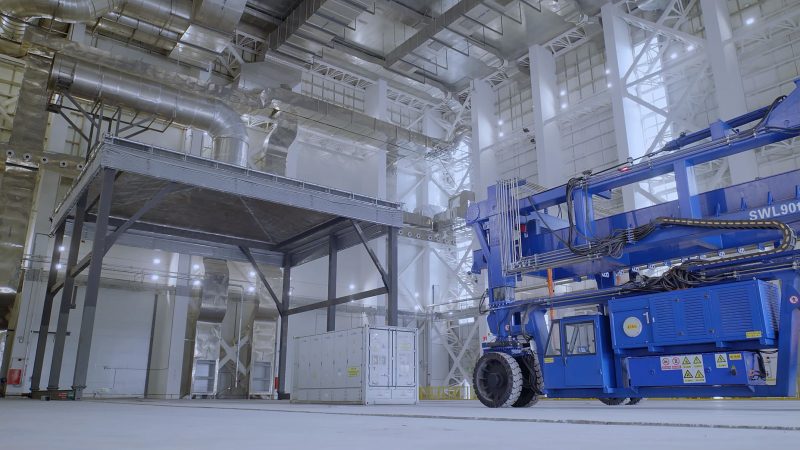
Large-scale combustion testing has attracted increasing attention in the industry, and both UL and CSA have released relevant standards. However, suitable test sites remain limited, and most testing still has to be carried out outdoors, where environmental conditions such as wind speed are difficult to control and the resulting data often cannot provide sufficiently reliable support for safety design.
The laboratory is the world’s first large indoor combustion facility equipped with a 20MW calorimeter. With 100,000 cubic meters of indoor combustion space, it can carry out explosion testing on nine large energy storage containers at the same time, fully reproducing the spatial scale and equipment density of a real energy storage station.
- Environment Reliability Laboratory: Full-Lifecycle Reliability Validation
The real battlefield for energy storage equipment may be the high temperatures and sandstorms of deserts, thin air and low pressure at high altitudes, year-after-year salt spray corrosion on coastal islands, and freezing conditions in extremely cold regions. After years of exposure to wind, sun and aging, can the equipment still operate stably and reliably? That is a question that must be answered before it leaves the factory.
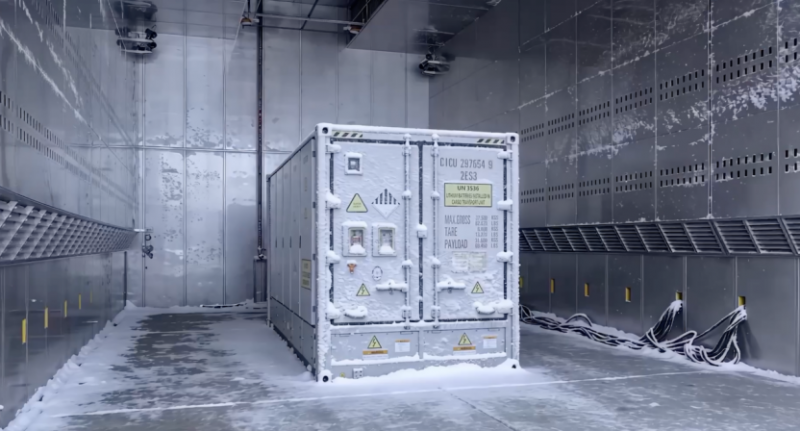
To address this, ESVL is equipped with five types of specialized test chambers and laboratories to verify energy storage equipment under real-world conditions.
- Climate Chamber: capable of simulating high-altitude, low-pressure conditions at up to 7,200 meters above sea level, with a temperature range from -45°C to +80°C, while supporting continuous charge and discharge under load during testing;
- Comprehensive Environmental Chamber: with a temperature range from -50°C to +100°C and humidity from 20% to 99%, supporting testing under a wide range of extreme climate conditions and meeting UL and IEC standards;
- Salt Spray Chamber: simulating high-salinity coastal environments to test the corrosion resistance of metal parts and prevent rust and insulation failure;
- Rain Chamber / Sand and Dust Chamber: covering the full range of dust protection from IP1X to IP6X and water resistance from IPX1 to IPX6, allowing full-container rain and sand testing to comprehensively verify sealing and protection performance, and reproduce real-world scenarios such as sand intrusion in Middle Eastern deserts and high-humidity monsoon rainfall.
After these harsh tests, high-voltage safety testing is also carried out to verify that the equipment remains stable and reliable after long-term exposure to wind, sun and aging. This is a core part of full-lifecycle validation for energy storage equipment.
- Electromagnetic Compatibility (EMC) Laboratory: Ensuring System Reliability Under Real Operating Conditions
Traditional EMC testing is conducted under ideal conditions and is far removed from the actual operating environment of energy storage stations, which means interference problems are often only exposed after commissioning.
Operational experience in China shows that about 30% of unplanned outages are caused by faults in weak-current equipment such as BMS and EMS. Because energy storage systems integrate strong and weak current at a high level, harsh electromagnetic environments are a major cause of such failures.
Most previous EMC testing for energy storage equipment has drawn on the experience of conventional power equipment, and those requirements are not fully applicable to energy storage systems. As a result, problems often only emerge after commissioning, sometimes causing frequent alarms or even system shutdowns.
ESVL has built the world’s only professional EMC laboratory capable of accommodating a full 40-foot container, equipped with a 65-ton turntable and a 5MW power supply, and able to complete EMC testing under real high-power charge and discharge conditions. The laboratory can accurately reproduce the complex electromagnetic environment of large-scale energy storage stations in actual operation, providing precise validation and optimization guidance for anti-interference design and improving communication and control reliability from the source.
Industry Value: Turning Industry Pain Points into Verified Value
The launch of ESVL marks a shift in the energy storage industry from specification claims to real-world validation, creating measurable value by addressing the sector’s three most pressing challenges.
- De-risking Grid Integration Through Real-World Validation
ESVL addresses this gap through the world’s first station-level grid integration laboratory, bringing critical grid validation under real-world conditions. With a 100 MVA grid simulator, an impedance simulator and a 1,000-node grid topology simulation, the platform can reproduce complex real-world grid conditions and support multi-unit parallel testing of more than 10 large-scale energy storage containers.
For grid operators, this means that issues can be identified and resolved before the system ever reaches the project site. That translates into shorter commissioning cycles, lower integration risk and stronger operational stability. According to assessments, ESVL can shorten equipment grid-connection delivery time by 30 to 60 days, while helping transform energy storage from a potential risk source into a stabilizing asset for the grid.
- Accelerating Global Market Access Through Real-World Validation
ESVL helps address the high cost of global grid compatibility adaptation by providing a one-stop validation platform for full-scenario testing across major global grid conditions. With a wide voltage range from 380 V to 35 kV and a frequency range from 15 Hz to 60 Hz, the platform enables energy storage systems to be validated under the diverse standards and operating conditions of global markets.
Through collaborative witness testing with leading certification bodies such as TÜV SÜD, TÜV Rheinland, CSA and China General Certification Center (CGC), ESVL helps companies pursue a more efficient one-test, globally recognized validation pathway.
For equipment manufacturers and integrators, this means shorter certification cycles, lower market-entry costs and faster access to critical global market opportunities. Test data also becomes an authoritative technical benchmark, strengthening differentiation in tenders and project bids.
- Strengthening Asset Credibility Through Real-World Validated Data
ESVL directly addresses the asset credibility crisis by providing traceable, verifiable and real-world validated data. By validating not only whether a system can operate, but whether it can remain stable, safe and reliable under real grid, real environment and real operation conditions, ESVL helps turn energy storage from a technology defined by assumptions into a long-duration asset defined by proof.
For investors, financial institutions, insurers, owners and regulators, this creates a more dependable basis for financial modeling, credit assessment, actuarial pricing and procurement decision-making. More broadly, it helps close the gap between claimed performance and real-world value, making energy storage more financeable, more insurable and more credible across its full lifecycle.
- Real-World Validation as Technical Due Diligence for Integrators
Real-world validated data is increasingly becoming a mandatory threshold in energy storage procurement and bidding. As clean energy continues to scale, grid operators and end users are placing ever-higher expectations on energy storage systems in terms of safety, grid adaptability and long-term reliability. In government and utility procurement, products that have not been validated under real operating conditions are increasingly unlikely to qualify.
In this sense, real-world validated energy storage serves as the industry’s technical due diligence report. Without it, even the strongest solution and the most competitive pricing may still fail to pass an owner’s due diligence review, a bank’s risk assessment or an insurer’s underwriting process.
For integrators that obtain real-world validation, the result is threefold: stronger customer trust, improved access to financing, and verified operational data that can support more informed decision-making across the project lifecycle.
- Real-World Data That Feeds Back into R&D
- Operational data feeds back into design: At ESVL, real degradation curves, cycling efficiency and thermal management performance can be generated under different operating conditions, enabling integrators to optimize control strategies and system architecture based on validated evidence rather than simulation alone.
- Grid integration data feeds back into technology selection: Real harmonic data from multi-unit parallel operation, together with measured frequency regulation response, gives integrators a clearer basis for determining the right topology and PCS configuration during the solution design stage — avoiding compatibility issues that would otherwise only surface after grid connection.
- Safety data feeds back into protective design: Real propagation paths and timing data for thermal runaway help integrators design fire protection schemes and physical isolation distances based on actual evidence, rather than relying solely on theoretical safety margins.
More broadly, ESVL is helping build a shared trust infrastructure for the entire energy storage ecosystem. By turning lab validation into real-world validated proof, the platform connects technology, finance, insurance, regulation and global market access around a common evidence base. This shift moves the industry away from fragmented claims and isolated testing toward standardized validation, evidence-based value creation and a more transparent growth model.
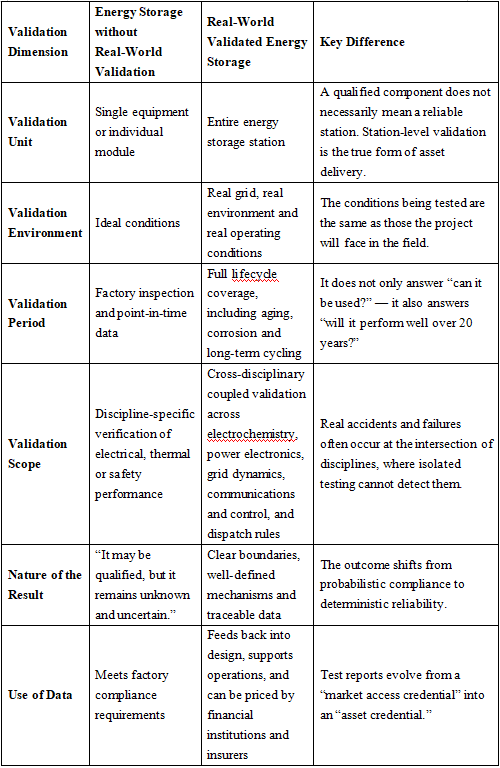
Real-World Validated Energy Storage vs. Energy Storage without Real-World Validation
What does “without real-world validation” mean? Simply put, it may be qualified — but it is not knowable, and not certain. Its parameters may have been tested at the equipment level, but only in laboratory settings, at the level of individual modules, and under conditions far removed from the realities of the power grid.
By contrast, real-world validated energy storage is verified at the station level, and has been tested under the closest possible approximation of real scenarios, real environments and real grid operating conditions.
Key Differences Between Real-World Validated Energy Storage and Energy Storage without Real-World Validation
CATL’s Comprehensive Strength in Building a Real-World Validated Energy Storage
CATL’s early establishment of ESVL and its leadership in the real world validated energy storage space are supported by five core pillars of strength. Together, these capabilities form a differentiated foundation that is difficult for others in the industry to replicate in the near term.
- Laboratory Validation: the world’s largest and most comprehensive one-stop testing and validation platform in the industry
- ESVL is a station-level validation platform designed to support testing across a broad range of operating scenarios.
- The platform integrates five major laboratory clusters, enabling a validation process that spans component testing, scenario testing and real-world verification.
- With 50 MW multi-unit parallel testing and 1,000-node grid simulation, ESVL helps shorten on-site grid-connection commissioning and shifts part of the validation process earlier in the project cycle.
- The platform also introduces multiple world-first capabilities
- Operational Validation: A Long-Term Track Record of Real-World Projects
- CATL’s validation framework is built not only on laboratory capabilities, but also on real-world operating data accumulated over years across multiple large-scale energy storage projects worldwide.
- In 2016, the company began developing 100 MWh-class lithium-ion battery energy storage technology, which led to a breakthrough in long-life zero-degradation technology in 2020 and the deployment of a 30 MW/108 MWh energy storage station in Jinjiang, China.
- CATL’s overseas solar-plus-storage projects, including the Quinbrook project in Australia, further reflect market recognition of its operational performance.
- In North America, a large solar-plus-storage project using CATL’s energy storage equipment achieved stronger-than-expected operating performance and subsequently secured refinancing at a lower interest rate, underscoring the market’s confidence in its long-term stability.
- Before ESVL was built, CATL’s smaller validation site had already achieved a post-visit conversion rate of up to 90% among customers. ESVL now systematizes and scales this validation effect, upgrading it into full-scenario, station-level verification so that reliability can be proven before deployment.
- Product Validation: “Zero Degradation” Technology That Defines Industry Lifespan Benchmarks
- Against the industry-wide trust crisis of 10-year advertised lifespan but less than 3 years in actual operation, CATL’s product validation capabilities provide a definitive answer.
- CATL’s TENER energy storage system, launched in 2024, is designed to deliver zero degradation in both power and capacity over five years. Its L-series long-life cells offer an energy density of 430 Wh/L and a single-container capacity of 6.25 MWh.
- ESVL provides an environment in which product performance claims can be independently validated before shipment, strengthening confidence in lifecycle performance.
- Market Recognition: Sustained Leadership and Market Acceptance
- Market share is the most direct proof of customer choice, while improved profitability further validates market recognition of product value.
- In 2025, CATL’s energy storage battery sales reached 121 GWh, with a global market share of 30.4%, ranking No. 1 worldwide for five consecutive years. These figures indicate strong customer acceptance and reflect the market’s willingness to recognize reliability, performance and long-term value.
- Ecosystem Building: Supporting Industry Trust and Standardization
- CATL is moving beyond the role of a traditional equipment supplier to build a global energy storage trust ecosystem grounded in real-world validation.
- CATL works closely with leading global certification bodies such as TÜV SÜD, TÜV Rheinland ,CSA and CGC to support witness testing and facilitate broader international acceptance.
- Generali, Italy’s largest insurance group, notes that insurability is a key step toward energy storage’s entry into the financial market and depends on credible validation data from independent third-party platforms such as ESVL.
- Positioned as a public platform open to the industry, ESVL contributes to the development of shared standards and a more credible ecosystem across certification, finance and policy.
The official operation of CATL’s Xiamen Energy Storage Validation Research Institute is more than the launch of a corporate laboratory — it is a major milestone in the global energy storage industry’s transition from extensive expansion to a new phase of sustainable scale-up. By providing scientific, rigorous and system-level third-party validation capabilities, ESVL is building a trustworthy foundation for the entire industry.



, the world’s largest and most comprehensive one-stop testing and validation…)