
PVTIME – Against the backdrop of accelerating decarbonisation of the European grid and the transition to a net-zero power system in the UK, this briefing analyses the market capitalisation hierarchy of the world’s 15 largest publicly traded energy storage enterprises as of 24 July 2026. It highlights geographical concentration, diverging business models and competitive dynamics across the battery manufacturing, grid-scale system integration and renewable asset operation industries. All valuations are in US dollars.
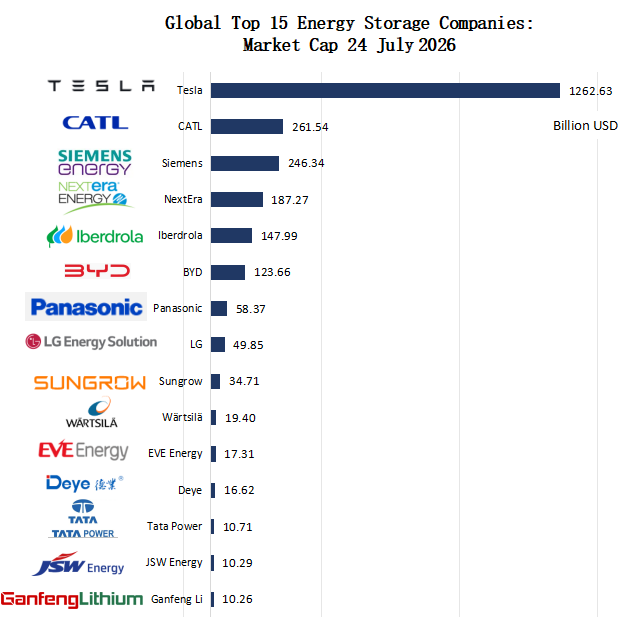
Tesla secures an overwhelming leading position with a market capitalisation of 1,262.63 billion USD, a figure more than four times that of second-placed CATL. Its unparalleled valuation is underpinned by two core pillars: the mass production of Megapack utility-scale battery energy storage systems (BESS) and Powerwall residential storage hardware, and synergies from electric vehicle manufacturing and energy management software platforms. This vertically integrated business model has cemented Tesla’s dominance in the distributed and grid-scale storage markets across the EU and North America. It also aligns closely with Britain’s capacity market requirements for flexible peaking power assets.
Six of the top 15 slots are occupied by Chinese enterprises, demonstrating comprehensive control over the global energy storage industrial chain from upstream to downstream. CATL is second with 261.54 billion USD, thanks to its leading global supply of lithium iron phosphate storage cells for large-scale stationary applications. BYD follows in sixth place with 123.66 billion USD, leveraging its blade battery technology for mobility and stationary storage applications. Tier-two Chinese specialists, including Sungrow (a global leader in power conversion systems and system integration with a value of 34.71 billion USD), EVE Energy, Deye and Ganfeng Lithium, complete the cohort. These companies specialise in power conversion equipment, square-format storage cells and lithium raw material supply, respectively. This collective strength highlights China’s ongoing cost and technological advantage in the production of electrochemical storage hardware.
European listed entities deliver robust market value via two distinct value propositions. Siemens Energy (USD 246.34 billion) ranks third, drawing valuation from its grid-grade power electronics, energy management software, and heritage in utility-grade storage system design, a critical enabler for European grid stability. Iberdrola (USD 147.99 billion) and Wärtsilä (USD 19.4 billion) embody the European asset owner and system integrator archetype: the Spanish utility has extensive pumped hydro and electrochemical storage portfolios for renewable balancing, and the Finnish firm provides hybrid engine-plus-storage flexible power plants. These firms directly address the UK and EU’s need for dispatchable, low-carbon capacity to offset intermittent wind and solar generation.
Japanese company Panasonic (USD 58.37 billion) and South Korean company LG Energy Solution (USD 49.85 billion) remain competitive by producing high-performance ternary battery cells for premium storage applications. Indian power utilities Tata Power, JSW Energy, and Ganfeng Lithium bring up the rear of the ranking, reflecting the rapidly growing demand for grid storage within the rollout programmes of renewable energy in emerging markets.
The league table highlights a clear bipolar competitive landscape: US conglomerates dominate through end-to-end product commercialisation, while Chinese manufacturers control the core hardware supply chain. Meanwhile, European industrial and utility groups retain critical market value through grid-aligned system solutions and operational assets, a model that is highly relevant for the United Kingdom’s ongoing deployment of large-scale battery storage systems in order to meet its legally binding net-zero obligations.

Scan the QR code to follow PVTIME official account on Wechat for latest news on PV+ES