
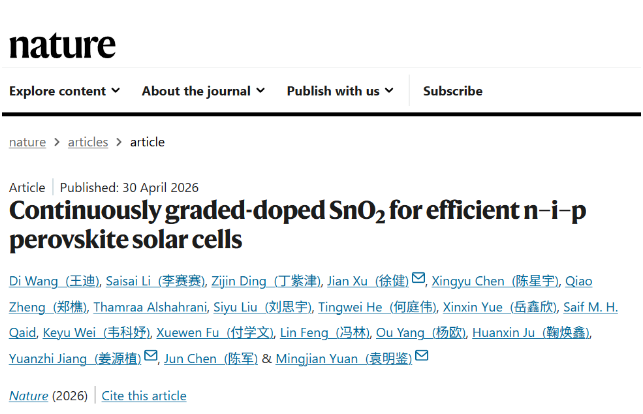
PVTIME – In collaboration with Beijing Institute of Technology, Nankai University’s College of Chemistry has set a new efficiency record for n-i-p perovskite solar cells. Their findings were published online in Nature on 30 April. Led by Professors Yuan Mingjian and Jiang Yuanzhi, alongside Researcher Xu Jian, the research team has resolved a key physical barrier that was limiting device performance, proposing an innovative gradient-doped electron transport layer design in the process.
The photovoltaic device, which has been certified internationally, achieved steady-state photoelectric conversion efficiency of 27.17% and reverse scan efficiency of 27.50%, setting a new standard for n-i-p perovskite technologies. Perovskite solar cells are regarded as a leading next-generation photovoltaic solution, offering high efficiency and scalable fabrication potential.
Previously, the efficiency of high-performance n-i-p devices was limited to around 26% due to non-radiative recombination losses from micro-nano textured substrates, and the underlying mechanisms were unclear. The team identified energy band mismatch and electron accumulation at the tin oxide (SnO₂) and perovskite interface as the core cause.
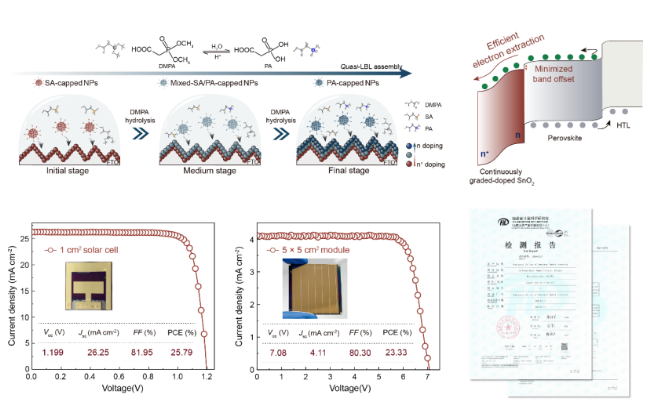
Through detailed analysis of the chemical bath deposition (CBD) process used to fabricate the SnO₂, the team established the relationships between the structure, activity and composition of the ligand, the oxygen vacancy content and the energy bands of the thin film. They developed a ligand competitive binding strategy to create an n⁺/n continuously gradient-doped SnO₂ electron transport layer, thereby resolving dual interface challenges and minimising recombination losses.
The device achieved an open-circuit voltage loss of just 295 millivolts, confirming the effective suppression of non-radiative recombination. This breakthrough clarifies the long-standing performance limitations of n-i-p devices and provides a universal design pathway for metal oxide electron transport layers, thereby supporting the development of stable and scalable perovskite modules.

Scan the QR code to follow PVTIME official account on Wechat for latest news on PV+ES