

PVTIME – France’s Commission de Régulation de l’Energie (CRE) has unveiled the tender specifications for the ninth round of its AO PPE2 PV Sol programme. The total allocation is 925MW, including a quota of 200MW reserved for small- and medium-scale installations. This is the first time that the framework has introduced supply chain resilience criteria, prohibiting full system assembly in dominant non-EU third countries and restricting inverters, solar cells and PV modules from such jurisdictions.
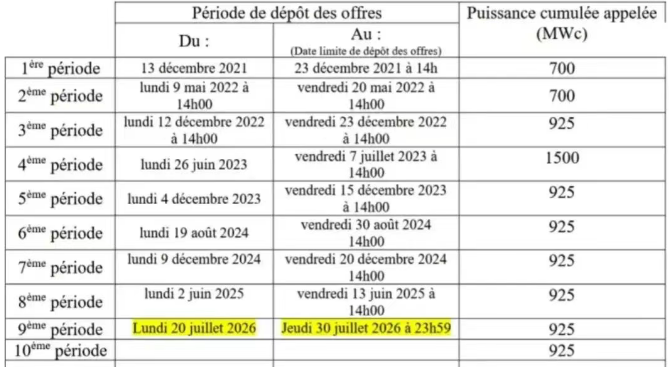
Alongside the tender, the French government has published a procurement timetable under its ten-year PP3 roadmap, which incorporates cybersecurity as a formal qualification requirement for tenders. France’s Energy Minister, Maud Bregeon, has stated that the policy aims to increase the output of low-carbon energy while strengthening national sovereignty. This is part of wider efforts to reduce reliance on modules manufactured in China.
The new rules outline eight key component categories: polysilicon, ingots, silicon wafers, solar cells, PV glass, modules, inverters and tracking brackets, and stipulate that at least four of these must be sourced from outside the specified third countries. Crucially, inverters, solar cells and PV modules must be among these four, thereby preventing compliance through non-core auxiliary components alone.
Inverters are a focal point of cybersecurity concerns due to their dual role in power conversion and their capabilities for data collection, remote communication and power regulation. French and EU authorities have expressed fears that covertly embedded software or remote manipulation could trigger large-scale shutdowns, tampering with power parameters and causing grid instability.
These concerns were heightened by a 2025 Reuters report which revealed that certain Chinese-made inverters contained undisclosed communication devices capable of bypassing utility firewalls to transmit data externally. Although the Chinese authorities dismissed the report as misleading, European lawmakers have urged the European Commission to restrict Chinese PV manufacturers’ access to critical EU energy infrastructure.
France’s restrictive measures on Chinese PV products have evolved over the past 15 years. They began with the introduction of carbon footprint certification in 2011, which set limits of between 200 and 550kg of CO₂ equivalent per kilowatt peak. This was followed by anti-dumping initiatives in 2012. Subsequent measures included subsidies prioritising European equipment in 2015, framework revisions favouring local supply chains in 2019, and tighter carbon footprint rules in 2021. Between 2024 and 2025, the focus shifted to Chinese inverters, which hold a 70% market share, as well as to Lithuanian restrictions on equipment from high-risk jurisdictions.
The ninth AO PPE2 tender embeds resilience and cybersecurity into entry criteria, marking the fifth phase of evolving restrictions spanning technical barriers, trade remedies, local support, cybersecurity oversight and supply chain segmentation, all of which are aligned with broader EU frameworks. Existing carbon footprint standards have not changed, so developers must comply with three requirements: using non-restricted sources for three core components, ensuring EU compliance in the assembly process, and achieving low-carbon qualifications. Tender evaluation prioritises lower bids, with smaller projects receiving higher rankings in the event of price parity. This favours distributed schemes over large-scale centralised installations, given the limited capacity of European manufacturers and the associated higher costs.
Tenders for small-scale and ground-mounted PV projects are scheduled for July this year, with tenders for industrial installations opening in autumn.

Scan the QR code to follow PVTIME official account on Wechat for latest news on PV+ES
 has unveiled the tender specifications for the ninth round of its AO PPE2 PV Sol programme. The total allocation is 925MW,…)