
PVTIME – This briefing is based solely on publicly released safety recall documents issued by international regulatory authorities and mainstream industry publications, as well as verified data from SolarQuotes, an independent third-party solar assessment platform. This compilation is intended purely for sector-wide observational analysis and carries no formal commercial evaluation or definitive quality ruling for any inverter manufacturer.
1. Inverters: Critical Grid Interface and Primary Fire Hazard Vector
Solar inverters perform the core DC-to-AC conversion that enables photovoltaic generation to feed into public grids. Their dense high-voltage circuitry and power semiconductors render them a predominant ignition source in PV asset fires, with DC arcing identified as the leading fire trigger.
PV arrays operate at DC potentials ranging from 600V to 1000V; short-circuit events generate extreme instantaneous thermal load. DC arc temperatures peak at 3000–7000℃, readily igniting adjacent combustible materials. Unlike alternating current arcs, DC arcs lack a zero-cross voltage cycle to self-extinguish, sustaining continuous combustion until circuit isolation.
2. Global Incident Archive: Verified Cases from Official Recall Notices
Case 1: Australian ACCC Voluntary Recall, November 2025 (PRA 2025/20703)
The Australian Competition and Consumer Commission mandated a safety recall for single-phase 8kW, 10kW and 12kW energy controllers distributed between 4 March and 18 November 2025, affecting approximately 100 units.
- Defect root cause: Overheating AC plug terminals leading to hardware degradation and fire risk
- Hazard assessment: Confirmed field incidents carry risks of property loss, severe bodily harm or fatality
- Remedial action: Complimentary replacement of revised AC plug assemblies plus a supplementary 2-year manufacturer warranty extension
- Source: Clean Energy Council Australia product recall portal
Case 2: Australian ACCC Recall, 16 September 2025 (PRA 2025/20623)
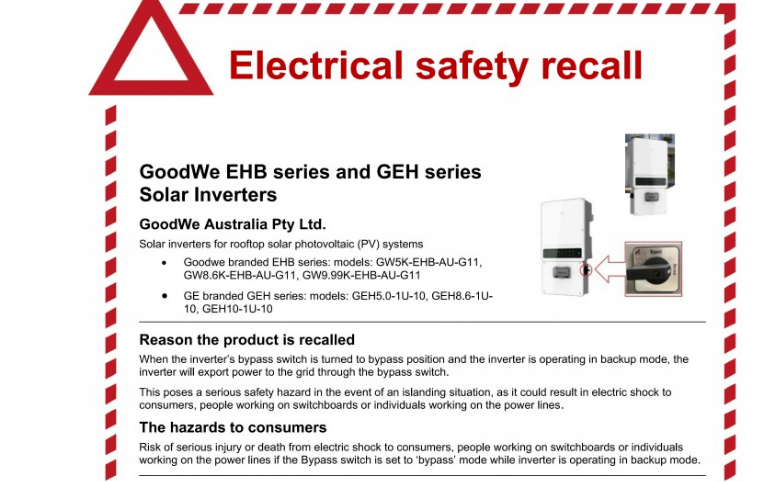
A safety notice covered EHB and GEH hybrid inverter models supplied between 3 May 2021 and 4 September 2025.
- Defect root cause: Unintended grid power export via the bypass switch when units operate in backup islanding mode
- Hazard assessment: Lethal electric shock risk to household occupants, switchboard technicians and overhead line maintenance operatives during grid isolation events
- Source: Clean Energy Council Australia product recall portal
Case 3: 40kW PV Plant Fire, Brazil, 2019 (Canal Solar Technical Case Study)
Field footage documented ignition triggered by MC4 connector disconnection during scheduled maintenance, despite prior isolation of AC circuit breakers and DC isolators.
- Root technical flaw: Mismatched string module counts creating persistent reverse current across parallel arrays, even with the inverter shut down
- Official conclusion: The event stemmed from fundamental design error rather than random operational accident
Case 4: Chinese Poverty-Alleviation PV Station Inverter Blaze, October 2018
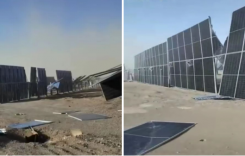
Industry media published on-site imagery showing multiple damaged inverter enclosures; brand identifiers were redacted to protect commercial privacy.
Case 5: Rooftop PV Control Cabinet Fire, Munich, Germany, 2012
Combustion originated within a rooftop PV electrical enclosure positioned at the positive-pressure air intake of a smoke escape stairwell, resulting in backflow of toxic fumes into occupied interior spaces with extensive structural damage recorded.
3. Third-Party Benchmarking: SolarQuotes Independent Inverter Brand Ratings
SolarQuotes, Australia’s leading impartial solar review repository, publishes annual installer-voted rankings for residential and commercial inverters (2025 survey):
- Fronius (Austria): 26% installer preference, average consumer rating 4.8/5 across over 8,600 verified user reviews; five consecutive years as top-ranked premium inverter brand, recognised for robust aftersales support and hardware reliability
- Sungrow (China): 19% installer preference, 4.7/5 customer score; podium-placed every year since 2021, designated a SolarQuotes recommended product, winning best value inverter in the 2024 Installers’ Choice Awards alongside second place for aftersales service
- GoodWe (China): 14% installer preference, 4.7/5 from 2,500+ user submissions; cost-effective entry-tier hardware favoured by installers for streamlined field commissioning
Historical commentary on German manufacturer SMA referenced widespread quality control failures in flagship AV40 models that permanently eroded market trust, with reports of premature unit breakdowns and permanent brand reputational damage.
4. Cross-Jurisdictional Fire Statistical Evidence: Systemic Industry Risk, Not Brand-Specific Failure
United States (USFA, Firetrace International 2022 Report)
Reported PV system fires rose from 25 incidents (2015) to 56 incidents (2018), mirroring national PV capacity expansion from under 30GW to over 60GW.
New South Wales, Australia (Fire and Rescue NSW data)
PV-related fires surged sixfold between 2018 (22 cases) and 2020 (139 cases), outpacing installed PV capacity growth (7.3GW to 20.7GW, less than triple expansion).
United Kingdom (BRE National Solar Centre Analysis)
A review of over 50 PV fire events allocated root causes as follows: DC isolators (18 fires), DC connectors (10 fires), inverters (7 fires). Over 36% of recorded blazes originated from improper on-site installation practices.
Cross-industry Reliability Metrics
- Inverter malfunctions account for 43% of all PV system faults, the single largest contributor to generation downtime
- Average industry-wide inverter failure rate stands at 2%, with a nominal operational lifespan of 10–15 years
- String inverters record a 0.89% failure rate within the first two service years, versus 0.055% for microinverter hardware
- 34.3% of residential inverters experience their first functional breakdown within 15 years of commissioning Sources: Automation of Electric Power Systems academic journal, People’s Daily state media, Sandia National Laboratories PVROM performance database
5. Root Cause Breakdown of Inverter Combustion Events
Catastrophic thermal failure typically arises from overlapping risks spanning product engineering, site installation and ongoing asset maintenance:
- Cost-cutting design compromises: Removal of AC-side isolation protection to reduce component expenditure enables unregulated stray current flow and short-circuit conditions
- Flawed system design/installation: Mismatched PV string sizing creates persistent reverse DC currents as observed in the 2019 Brazilian 40kW plant incident
- Neglected routine maintenance: Inverter cooling fans and ventilation grilles accumulate dust and debris, trapping waste heat and accelerating thermal degradation of internal power electronics
6. Five Industry Standard Protocols for Inverter Fire Mitigation
- Rigorous hardware selection benchmark: Adopt the SolarQuotes due diligence standard:Would I put this on my mother’s roof?
- Certified professional installation: All PV design and wiring works must be delivered by accredited solar technicians to eliminate fundamental design defects
- Mandatory AFCI protection: Arc Fault Circuit Interrupters continuously monitor DC circuit signatures and isolate supply upon arcing detection, the primary safeguard against PV ignition
- Scheduled preventive maintenance: Quarterly inspections of cooling hardware, terminal connections and cable junctions to clear blockages and resolve loose wiring
- Clear emergency isolation signage: Prominent site labelling outlining full DC and AC circuit shutdown procedures for all on-site personnel
7. Concluding Remarks: Safety as a Core Commercial Imperative
Inverter fires incur far greater financial and reputational losses than proactive safety investment, threatening physical assets, operator trust and human life. Historical field incidents and regulatory recalls demonstrate that hardware combustion risk is a cross-industry systemic challenge rather than an isolated brand defect. For long-term sustainable PV deployment, operational safety is non-negotiable rather than an incremental overhead; market participants prioritising robust fire mitigation will secure sustained competitive advantage across the renewable energy value chain.

Scan the QR code to follow PVTIME official account on Wechat for latest news on PV+ES