

PVTIME – In response to the accelerating global deployment of grid-scale energy storage, battery manufacturers are developing larger-capacity cells as a key strategy to reduce system-level bill of materials (BoM) costs, minimise installation labour, and streamline containerised energy storage system architecture. Larger-format cells reduce the number of internal connections within battery racks, helping to mitigate contact-related losses and potential fault points.
Data from official manufacturer disclosures indicates that Chinese suppliers currently dominate the high-capacity segment of the mass-produced energy storage cell market.
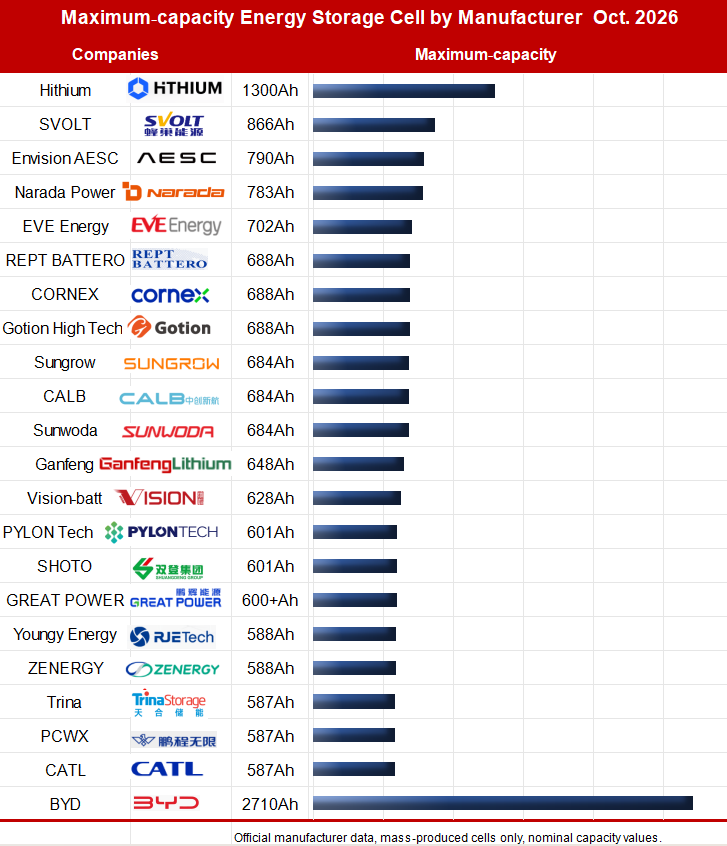
BYD stands out with its industry-leading 2710Ah energy-storage-dedicated Blade Battery. Unveiled at the International Digital Energy Exhibition in September 2025, it is integrated into BYD’s Haohan ESS, a containerised storage solution with a rated capacity of 14.56MWh. According to BYD’s 2026 half-year financial report, Haohan energy storage systems equipped with the 2710Ah cell began entering serial commercial delivery in the first half of 2026. The product has secured major framework agreements with global energy companies, including Masdar and Grenergy, as well as domestic contracts with China General Nuclear Power Group. It has also been launched commercially in the Japanese market. It should be noted that the 2710Ah bare cell is not available for sale to third-party integrators separately, it is only supplied as part of the complete Haohan ESS product.
A large group of Chinese battery manufacturers have started mass-producing high-capacity storage cells. HiTHIUM is leading the way among independent energy storage specialists with its 1,300Ah mass-produced cell, which is intended for use in utility-scale projects. SVOLT’s flagship storage cell has a capacity of 866Ah, while Envision AESC has launched a product with a capacity of 790Ah for grid-connected deployments. Several major manufacturers have centred their flagship offerings around the 680-700Ah range: EVE Energy markets a 702Ah cell, while REPT BATTERY, CORNEX and Gotion High-Tech have released 688Ah mass-produced variants. Sungrow, CALB and Sunwoda each offer 684Ah storage cells for large-scale stationary applications. Other suppliers, including Ganfeng Lithium, Vision-Batt, PylonTech and SHOTO, have commercialised cells ranging from 580Ah to 648Ah for the global stationary storage market. All referenced figures relate to the nominal capacity of mass-produced hardware, excluding laboratory prototypes or pre-production samples.
In sharp contrast to developments in China, non-Chinese battery producers have yet to commercialise storage cells with a capacity above 300Ah for stationary applications, as evidenced by their official public product documentation. Leading South Korean original equipment manufacturers (OEMs) represent the highest-capacity mass-produced options in this peer group. LG Energy Solution’s largest LFP storage cell is 290Ah for ESS deployments. Samsung SDI offers a 280Ah LFP cell optimised for grid-scale use, and SK On supplies a 250Ah LFP cell which is set to begin deliveries to North American energy storage projects in 2026.
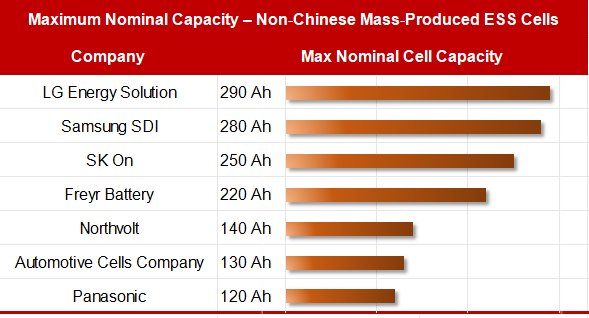
European and North American players have more modest cell capacity roadmaps. Northvolt, based in Sweden, has a mass-produced storage cell within its Voltpack Core system with a capacity of 140Ah; no ultra-high-Ah storage cell is listed in its public product portfolio. Norwegian company Freyr Battery has a 220Ah semi-solid storage cell in its product range. The Automotive Cells Company, a French-German joint venture, primarily focuses on automotive traction batteries and does not publish any high-capacity storage cell specifications for mass deployment. Panasonic of Japan provides a 120Ah cell targeted at the residential and commercial-industrial storage segments. Tesla’s Megapack delivers 19.3MWh per unit; however, the company does not publish official Ah-rating data for its internal cells, instead selling complete container systems rather than discrete battery cells.
This capacity gap arises from several interacting factors. Chinese manufacturers have prioritised utility-scale LFP storage as a core strategic vertical, iterating large-format cell designs tailored for stationary use cases. Many overseas producers still prioritise electric-vehicle traction cells in their R&D, treating storage as a secondary application. Supply-chain constraints and differing local safety certification frameworks also create barriers to the rapid rollout of ultra-large-format cells outside China.
Looking ahead, the global storage-cell market will be shaped by two competing trajectories. On the one hand, Chinese suppliers are expected to continue increasing nominal cell capacity, introducing new ultra-large cell designs to global project tenders. Conversely, non-Chinese original equipment manufacturers may gradually increase cell sizes, although current official product pipelines do not indicate any near-term jumps to 600Ah and above for mass-produced storage hardware. Ultimately, system-level validation, fire-safety compliance and real-world field performance will determine the extent to which these giant-format cells are adopted across global markets, rather than nominal Ah ratings alone. When selecting cell formats for grid-scale assets, project developers will balance cost-reduction benefits against qualification requirements, supply-chain diversity, and long-term operational risk.

…)