

PVTIME – On 14 October, Ben Backwell, Chief Executive of the Global Wind Energy Council (GWEC) and Chair of the Global Renewables Alliance, delivered a keynote address at the opening ceremony of the 2026 China Wind Power Conference and Exhibition. He presented fresh industry statistics showing that the world added 165GW of newly grid connected wind capacity in 2025, with 178GW of mechanically installed capacity, marking an all time high. China accounted for 120GW of this new build, strongly driving global wind deployment, while Germany, India, the United States and other markets also delivered robust growth.
In his address, Backwell noted that geopolitical instability underscores the value of wind power, which can reduce national reliance on fossil fuel imports and bolster energy security. Surging electricity demand from industry, transport and artificial intelligence data centres creates substantial opportunities for wind energy, alongside formidable challenges. He identified insufficiently rapid grid expansion relative to renewable deployment as the sector’s most pressing constraint.
To tackle this issue, GWEC, in partnership with the Global Renewables Alliance, has launched a Global Grid Initiative. The initiative will work with governments to deliver technical assistance, share best practice with businesses and stakeholders, accelerate investment in innovation, and refine regulatory and market frameworks.
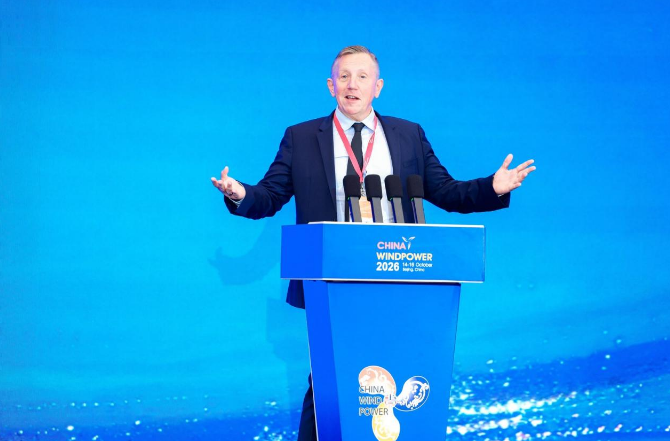
Extracts from the keynote address
Backwell opened by welcoming delegates to the 2026 China Wind Power Conference and Exhibition, acknowledging co hosts Mr Qin Haiyan, Mr Li Junfeng and CCICED. He remarked on the venue, recalling colder conditions at the site the previous year and highlighting the comfortable environment for this year’s event.
He observed that the conference was well timed amid worldwide efforts to transform energy systems. Meeting rising power demand from industrial activity, transport and artificial intelligence, and installing the necessary generation capacity at an appropriate pace, was critical, and raised the question of whether the sector was adequately prepared.
Wind energy has been central to innovation across the energy landscape from its earliest days, Backwell explained. Driven by continuous innovation, wind power has reshaped global energy systems, progressing from small pilot projects to today’s deployment of giant turbines and large scale wind farms. Over the past two decades, the technology has evolved from a niche alternative power source into one of the primary electricity supplies for most major industrial economies.
The sector has overcome widespread scepticism, he added. The industry has secured public acceptance, unlocked investment, created employment and cut costs to improve commercial competitiveness. Wind deployment has displaced growing volumes of carbon dioxide, reduced emissions and supported the global vision of a safe, clean energy future.
Backwell stated that the wind sector is now experiencing rapid expansion against a backdrop of steeply rising electricity demand as economies and consumers pursue electrification. Citing figures from GWEC’s Global Wind Report published earlier in the year, he confirmed that 2025 represented the strongest year ever for wind development, with 165GW of new grid connected capacity and 178GW of mechanically installed capacity. China’s 120GW contribution constituted an extraordinary milestone and was the primary engine for global growth; Germany, India, the United States and numerous other markets also recorded their strongest annual performance.
Geopolitical turbulence has disrupted energy markets and elevated the importance of energy transition. Wind power was developed as an alternative to mitigate price volatility and import dependency, two defining vulnerabilities of fossil fuel based economies. Wind research and prototype work began in the early 1970s following the energy crisis. By the mid 1970s, it had become clear that import dependence posed a persistent threat to energy security, while fossil fuel price shocks imposed severe economic damage.
Governments from London and Rome to Manila and Seoul are therefore prioritising economic electrification. This is why GWEC places energy security at the heart of its governmental collaboration, and why the Global Renewables Alliance is working with states and investors to deliver global fast electrification commitments. At COP31 in Antalya, Turkey highlighted accelerated electrification across transport, heating, cooling and industry, together with surging load requirements from AI data centres. These trends create major opportunities for wind, solar and other renewables while introducing new demands and complex challenges. While the transition offers significant economic potential, scaling development at the required speed remains an arduous undertaking.
Backwell singled out grid development as the most urgent challenge, as network build out cannot keep pace with renewable growth. Countries must scale investment in grid technology both for new infrastructure and the optimisation of existing assets. Improved coordinated planning, demand side management and network operation will maximise utilisation of available grid capacity.
The GWEC team had toured multiple facilities across China this week, visiting enterprises in Suzhou, Hangzhou and Inner Mongolia. Backwell commended the remarkable progress witnessed across these sites, noting the mission slogan for the visit: “The Future Is Here”. Innovation is already underway on the ground, and faster policy development is required to deploy these technologies and construct modern power systems.
This context underpins the Global Grid Initiative launched jointly by GWEC and the Global Renewables Alliance. The partnership will provide technical assistance in cooperation with governments, disseminate best practice with industry and stakeholders, scale investment in innovation and strengthen regulatory and market frameworks.
Variable renewable energy has now moved into the mainstream market, Backwell continued. As Mr Qin had outlined earlier, supply demand imbalances and negative pricing occur routinely across global markets. In this environment, high quality wind assets deliver reliable electricity with favourable generation profiles and capacity factors.
These benefits cannot be realised by wind power in isolation, however. The industry does not merely supply turbines; it delivers integrated energy solutions. As announced by Mr Qin that morning, wind and solar power define the strategic direction for the wider sector. A hybrid first approach is required, combining wind, solar, energy storage and grid technologies to design optimised power projects aligned with market needs and secure competitive pricing.
The shared objective is to deliver stable renewable power to meet demand worldwide. Wind energy has an expanding role in supporting AI infrastructure, and rising demand for data centres represents a substantial opportunity. Backwell referenced a site visit in Inner Mongolia the previous day to a data centre built alongside a wind farm. Such projects demonstrate that green, sustainable AI data centres are technically viable. With enabling policy design, these facilities can be configured to avoid persistent grid stress, protecting existing consumers and the natural environment from unsustainable pressure while cutting carbon emissions.
Achieving this requires collaborative frameworks between governments and investors to deliver the additional generation capacity required, consistent with climate and environmental commitments. Failure to act decisively risks making the expansion of AI data centres unsustainable. Unabated growth could rely heavily on fossil fuel generation, which would eventually trigger social and political pushback and hinder sector progress. It falls to the industry to prove that a sustainable pathway is achievable.
Backwell noted the presence of sustainable energy developers in China capable of making the investments required for data centres and related infrastructure. Over the past 21 years, GWEC has fostered conditions to advance joint projects between GWEC members and Chinese firms, supporting continuous innovation and knowledge sharing. GWEC has engaged with China’s wind sector from an early stage. Two decades ago, in 2007 and 2008, the sector workforce totalled only a few hundred people. Today the exhibition can draw between 100,000 and 150,000 attendees, illustrating the scale of growth and strength of cross border collaboration.
Next year marks the 20th anniversary of wind power development in China. GWEC plans a special commemorative event, inviting all those who have contributed over the past two decades to take part. The industry is now targeting annual installations of 200GW. Wind power as a technology has a roughly 40 year history, with far lower deployment volumes back in 2009. When planning for the next 40 to 60 years of development, the sector must retain awareness of its origins while keeping sight of long term objectives.
Many jurisdictions have experienced shifts in grid access rules, regulation and policy, alongside intensifying global market competition. Some regions face overcapacity and below normal market pricing. Cross border competition for energy resources and competing national interests also create headwinds for national economies and the wider wind industry.
Negative narratives around wind power continue to emerge periodically, sending adverse market signals. GWEC maintains a clear standpoint and seeks to communicate the sector’s message globally.

 and Chair of the Global Renewables Alliance, delivered a keynote address at the opening ceremony…)