

PVTIME – The latest trade data from China’s General Administration of Customs (GACC) for January to August 2026 reveals a complex story for the global photovoltaic supply chain. Although unit volumes have decreased, export values have increased, indicating a structural shift towards higher-value systems and a significant geographical change. The data reveals an industry that is not merely surviving consolidation, but actively recalibrating its global footprint by moving into high-growth emerging markets beyond traditional European strongholds.
The Value-Volume Divergence: A sign of maturity?
The most immediate headline is the divergence between quantity and value. In August 2026 alone, China exported 4.94 million inverter units, contributing to a year-to-date total of 34.16 million units. This represents a decline from the 34.90 million units shipped during the same period in 2025. However, this volume contraction masks a robust recovery in revenue. Export value from January to August 2026 reached USD 76.28 billion, up significantly from USD 60.5 billion in the same period in 2025. August’s monthly export value was USD 10.05 billion.
This discrepancy suggests that the era of competing solely on the basis of low-cost, entry-level hardware may be coming to an end. The increase in total value despite lower unit counts implies a shift in the product mix towards higher-capacity commercial and industrial inverters, hybrid systems with integrated storage capabilities and premium units required for complex grid support functions in mature markets. As global energy policies increasingly mandate grid stability and storage integration, the average selling price per unit appears to be rising, offsetting the reduction in sheer volume.
Europe: The Enduring Bedrock
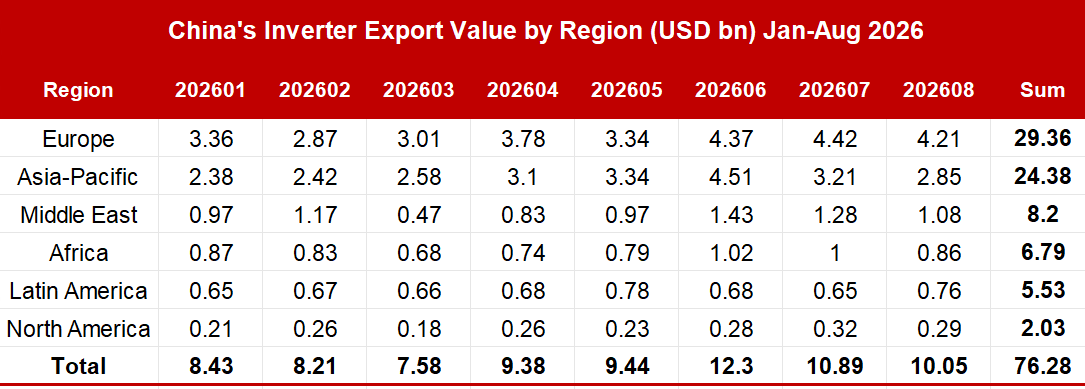
Despite the narrative of diversification, Europe remains the anchor of China’s inverter trade. The region accounted for USD 29.36 billion of the total export value in the first eight months of 2026. This dominance is underpinned by strong demand across both Western and Central Europe.
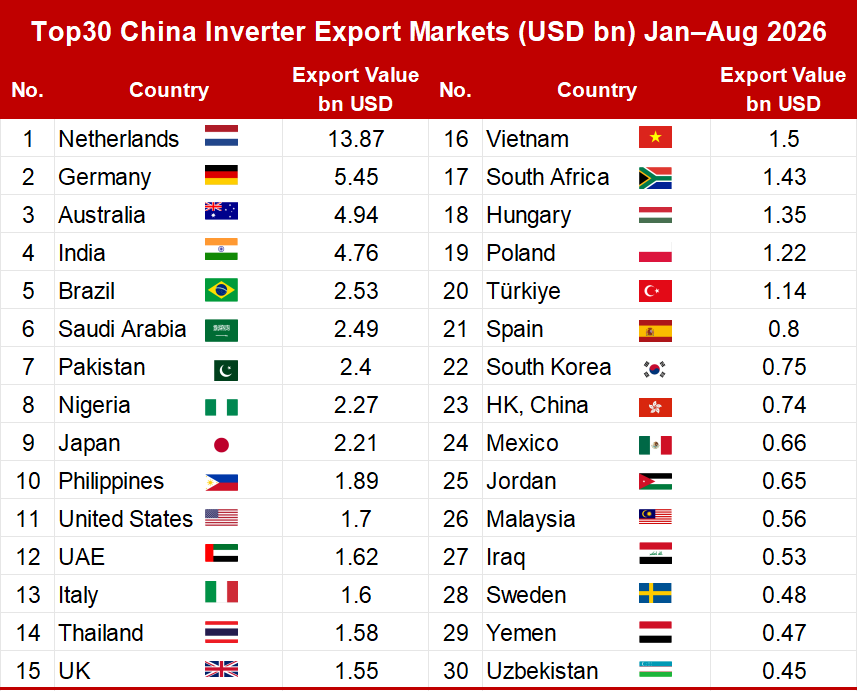
Country-level data reinforces this depth. The Netherlands leads the way with USD 13.87 billion, followed by Germany with USD 5.45 billion. Crucially, however, the European market is not monolithic; rather, it is supported by a wide tier of secondary markets, including those in Italy, the UK, Hungary, Poland, Turkey, Spain and Sweden. The widespread adoption across these diverse regulatory environments suggests that European demand is driven by fundamental energy security concerns and well-established subsidy frameworks, rather than transient speculation.
The Rise of the Global South
While Europe provides stability, the growth engines are increasingly located in the Global South. The Asia-Pacific region has emerged as a strong second pillar, generating $24.38 billion in exports. This is driven by large-scale utility and distributed projects in India, Australia, and Southeast Asian countries such as Thailand, the Philippines, Vietnam, Japan, and South Korea.
Beyond Asia, the data highlights the rapid electrification and decarbonisation efforts in other developing regions. The Middle East exported USD 8.20 billion, with Saudi Arabia and the UAE leading the way as they diversify away from oil dependence. Africa contributed $6.79 billion, with Nigeria and South Africa serving as key hubs for improving energy access. Similarly, Brazil’s substantial demand anchored Latin America’s total of USD 5.53 billion. In contrast, North America remains a relatively minor destination, with exports totalling USD 2.03 billion, which is likely due to persistent trade friction and localisation requirements.
This geographical spread suggests that Chinese manufacturers have adopted a successful hedging strategy. As trade barriers potentially loom in traditional Western markets, the industry has cultivated strong supply chain relationships in regions where energy demand growth exceeds grid infrastructure capacity, requiring robust inverter and storage solutions.
Domestic hubs: The coastal powerhouses
Production and export logistics remain heavily concentrated in China’s coastal manufacturing regions. Guangdong province is the main gateway, accounting for USD 27.5 billion in exports thanks to its electronics supply chain ecosystem. Zhejiang follows closely behind with USD 22.4 billion; it is home to several major PV component manufacturers. Jiangsu (USD 11.9 billion) and Anhui (USD 7.4 billion) complete the top four, demonstrating an industrial advantage that is difficult for other nations to replicate in the short term.
Future outlook: Grid integration and storage
Looking ahead to the rest of 2026 and beyond, there are several trends that warrant attention. Firstly, the ‘value over volume’ dynamic is likely to persist as grids become increasingly saturated with renewable energy sources, necessitating the use of more sophisticated and expensive inverters that can perform advanced frequency regulation and voltage support.
Secondly, although Europe remains the largest market, its growth rate may stabilise in comparison to the explosive potential of markets such as Saudi Arabia, India and Brazil. Policy shifts in these emerging economies, such as local content requirements, will be the next critical variable for Chinese exporters to navigate.
Finally, the data raises questions about sustainability. As the market matures, will we see a further division between commodity inverters for developing grids and smart inverters for advanced economies? How will the inevitable rise in non-Chinese manufacturing capacity in India and the US reshape these trade flows by 2027? For now, however, the data confirms that China’s inverter sector is firmly embedded in the global energy transition, evolving from a volume supplier to a critical value provider.
Edit




 for January to August 2026 reveals a complex story for the global photovoltaic supply chain. Although unit…)