
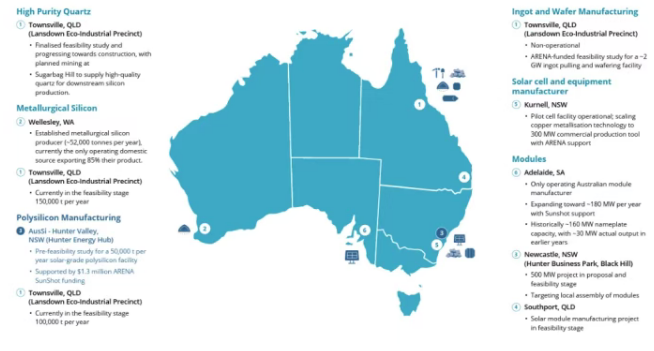
PVTIME – A study by AusSi, backed by ARENA and delivered under Australia’s Solar Sunshot programme, has verified the technical and commercial viability of a 50,000 tonne/Y polysilicon facility at the Hunter Energy Hub in New South Wales. The analysis confirms that, with targeted government support, Australia could establish a competitive, export-focused, large-scale polysilicon industry.
The project requires total capital investment of AUD 2.5–3.5 billion (USD 1.79–2.48 billion). With a targeted internal rate of return of 20–30%, the scheme relies on AUD 1–1.5 billion in government grants upfront and annual production subsidies of approximately AUD 200 million for ten years, which aligns with standard returns for capital-intensive industrial assets.
Polysilicon manufacturing is the most power-intensive stage of the PV supply chain, with 95% of global production currently concentrated in China. The heightened global emphasis on supply chain resilience, sustainability, and labour standards has prompted the US, the EU, and India to prioritise diversified polysilicon sourcing.
Global non-Chinese polysilicon supply gaps are projected to reach 240,000 tonnes by 2035 and 350,000 tonnes by 2040. The accelerated expansion of downstream solar manufacturing has outpaced the growth of upstream supply, leaving global non-Chinese production unable to meet future demand. Non-Chinese polysilicon currently trades at a premium of 300–500%, reflecting structural supply shortages and supply chain security pricing.
In 2025, global non-Chinese polysilicon capacity stood at 199,000 tonnes, with only one third allocated to solar-grade production. Key solar-grade output from Malaysia, the US and Germany is 27,000, 18,000 and 21,000 tonnes respectively, accounting for just 5% of China’s annual output of 1.15 million tonnes of solar polysilicon, which highlights Australia’s reliance on imported Chinese PV components.
The AusSi project has secured the endorsement of downstream solar manufacturers from six different countries. Market demand for Australian polysilicon is driven by supply chain diversification, adherence to ESG and labour standards, and long-term supply security, covering all solar manufacturing segments.
The Hunter facility’s annual output will support the production of 27GW of solar modules, 90–95% of which is destined for export markets, equivalent to five times Australia’s current annual solar installation capacity.
Global trade and regulatory policies have reshaped competition in the polysilicon market. For example, the US applies Section 301 tariffs of 50–60% on Chinese imports and 14–3521% contingent duties on regional products. There are also restrictions on materials sourced from Xinjiang and eligibility rules under the IRA bar projects with over 25% Chinese equity.
The EU’s Carbon Border Adjustment Mechanism penalises high-carbon, coal-fired polysilicon production, while the Net Zero Industry Act incentivises transparent, low-emission supply chains by offering commercial and tender advantages, thereby supporting green polysilicon premium pricing.
India has imposed a 20% border tax on solar modules and cells, with plans to expand tariffs to silicon wafers and ingots. Manufacturing incentives favour non-Chinese supply chains. Japan is pursuing supply diversification through corporate procurement standards and international industry collaboration.
The AusSi report highlights Australia’s competitive advantages in terms of low operational risk, verified sustainability credentials, IP protection, mature infrastructure, and cost-efficient production inputs for polysilicon manufacturing.
Situated within a designated Renewable Energy Zone, the Hunter Energy Hub provides comprehensive industrial, grid, water and transport infrastructure, backed by integrated solar and battery storage systems. The site’s transition from coal generation to a clean energy hub provides stable power and peak regulation capacity for industrial use.
The project will strengthen Australia’s independence in the PV supply chain, expand its participation in global renewable markets and deliver economic benefits in the form of new investment, export revenue and skilled employment. It will also facilitate the transition of the workforce from the fossil fuel sector to the renewable energy sector.
Australia’s existing annual metallurgical-grade silicon production capacity is 50,000 tonnes, and there are plans to expand this to 200,000 tonnes. Polysilicon production consumes 55kWh per kilogram, equating to an annual power demand of 2.7TWh for the proposed facility. As power costs account for over 40% of production expenditure, low-cost renewable power is critical to the competitiveness of the project.
Construction costs for Australian polysilicon projects are two to three times higher than for Chinese projects, due to local regulatory standards, labour fees, and first-of-project contingency provisions. Subsequent domestic developments will build on the experience gained from this initial project to improve profitability and establish Australia as a leading, low-cost, non-Chinese polysilicon supplier.
Quinbrook Infrastructure Partners is developing a parallel polysilicon project in Queensland as part of the Northern Quartz Park scheme. Granted state key project status in 2024, the facility is scheduled to commence commercial operations in 2030. It will be powered by on-site renewable energy and supported by a proposed 750MW battery energy storage system to facilitate high-energy manufacturing operations.
Despite uncertainties surrounding the final investment decision, the AusSi study recommends immediate progression to subsequent development stages. The early initiation of planning, engineering and financing work is essential if the facility is to be commissioned in the early 2030s and if the forecast global non-Chinese polysilicon supply deficit is to be filled.

Scan the QR code to follow PVTIME official account on Wechat for latest news on PV+ES