
PVTIME – The financial results for the first half of the year for China’s leading inverter manufacturers reveal a sharply divided market landscape, with a small group of firms capturing the vast majority of sector profits amid intense global competition. Converted to US dollars at the exchange rate on 1 July 2026, the dataset illustrates the growing disparity between market leaders and smaller competitors, with export-driven growth coexisting with margin pressure across the industry.
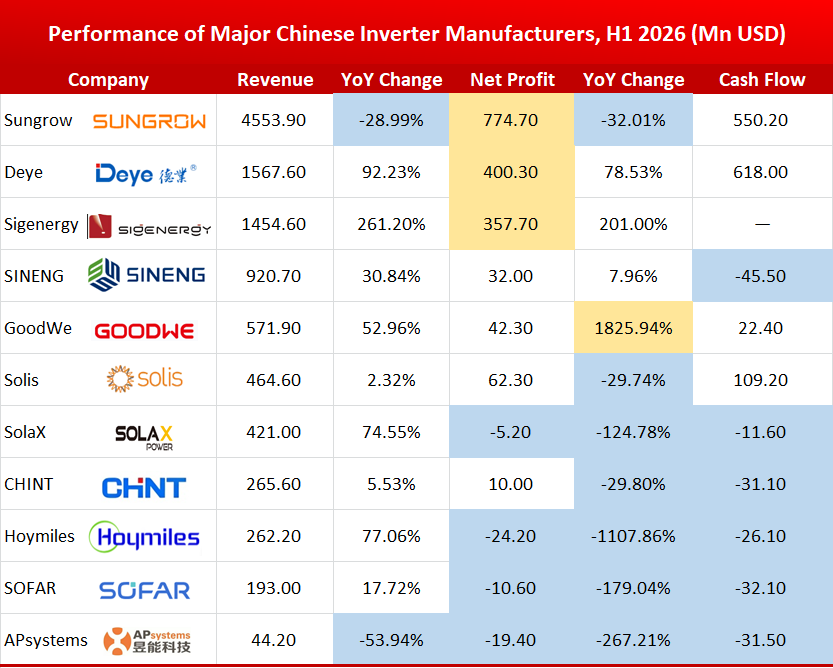
Three companies, Sungrow, Deye and Sigenergy, dominate profitability within the sample group. Sungrow recorded the highest revenue within the group at 4,553.90 Mn USD, alongside a net profit of 774.70 Mn USD. Nevertheless, the business faced headwinds, with revenue and net profit falling by 28.99% and 32.01% year-on-year, respectively. Robust operating cash flow of 550.20 Mn USD demonstrates the group’s solid cash-generating capacity despite top-line contraction.
Deye delivered standout operational expansion in the first half of 2026. Its revenue reached 1,567.60 Mn USD, marking 92.23% year-on-year growth, while net profit rose 78.53% to 400.30 Mn USD. Backed by a robust cash position of 618.00 Mn USD, Deye’s performance indicates robust demand for its residential and commercial storage inverter products in overseas markets. Sigenergy posted the most dramatic profit expansion of the cohort. With revenue of 1,454.60 Mn USD (up 261.20% year-on-year), its net profit reached 357.70 Mn USD, driven by surging demand for its integrated energy storage hardware. No cash flow figure was published for Sigenergy within this dataset. Together, these three companies account for around 95% of the total net profit among the 11 manufacturers surveyed, highlighting the extreme concentration of profits within China’s inverter sector.
Mid-tier firms have shown mixed operational outcomes. GoodWe increased its revenue by 52.96% to 571.90 Mn USD. Its net profit increased by 1,825.94%, though this large percentage increase stems from a comparatively low profit base in the previous year, with cash flow standing at 22.40 Mn USD. Solis maintained stable revenue growth of just 2.32% to reach 464.60 Mn USD, but net profit declined by 29.74% to reach 62.30 Mn USD despite positive cash flow of 109.20 Mn USD. Sineng recorded moderate revenue growth of 30.84% to 920.70 Mn USD, as well as modest profit growth. However, it also registered negative cash flow of -45.50 Mn USD, signalling working capital stress.
Several smaller manufacturers reported financial losses in the first half of the year. Solax Power increased its revenue by 74.55% to 421.00 Mn USD, but posted a net loss of -5.20 Mn USD and had negative cash flow. Hoymiles saw revenue rise by 77.06% to 262.20 Mn USD, while net profit plunged into negative territory at -24.20 Mn USD. Both Sofar and APsystems also recorded net losses alongside negative cash flow. Chint Power achieved a positive net profit of 10.00 Mn USD, but experienced falling profitability and negative operating cash flow.
The H1 figures provide a clear indication to observers of the global renewable energy sector. Strong overseas demand for hybrid solar-storage inverters is driving rapid top-line expansion for many Chinese suppliers. Nevertheless, fierce competition is putting pressure on margins and profits are heavily concentrated among a small number of well-established, export-focused groups. Some manufacturers are increasing their sales volumes without managing to convert higher turnover into sustainable profits or positive cash generation. As we move into the second half of 2026, the sector will continue to navigate shifts in global trade policy, volatile component prices and intensifying competition in both the utility-scale and distributed energy markets.