
PVTIME – The official global energy storage system shipment rankings for the first half of 2026 have been published by InfoLink. Based on the organisation’s specialised global energy storage supply chain database, the publication provides an in-depth statistical analysis of shipment performance among international energy storage system manufacturers during the first half of the year.
Global energy storage system shipments totalled 303.40GWh during this period, marking an 83.45% year-on-year increase. Over the period, overseas residential, commercial and industrial energy storage installations achieved rapid expansion, alongside sustained strong growth in utility-scale energy storage capacity. Markets outside China, the US and Europe accounted for over 20% of total global system shipments during this period, and full-year market share forecasts suggest this figure will rise to around 25% by the end of 2026.
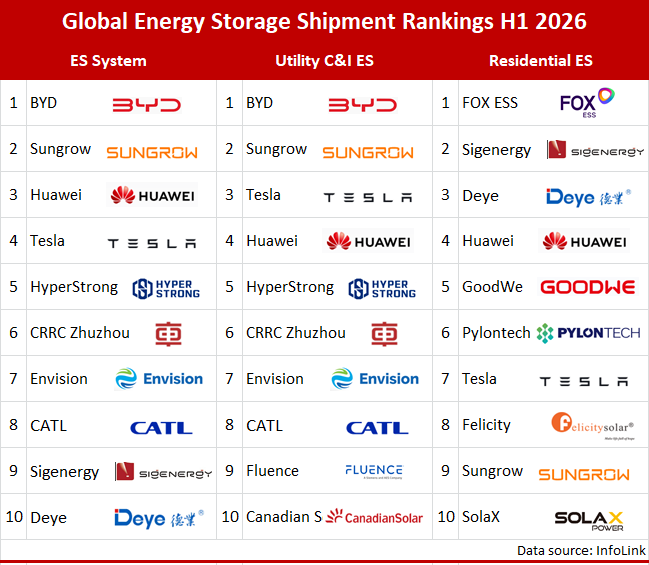
The ranked shipment statistics cover energy storage projects in the utility-scale, commercial and industrial, residential and communication base station sectors. Throughout the H1 2026, BYD, Sungrow, Huawei, Tesla and HyperStrong claimed the top five positions globally in energy storage system shipments. While intense competition continues to prevail among peers operating within the same market tier, the worldwide industry landscape has formed clear hierarchical divisions.
Tesla’s improved shipment performance in the second quarter has established a competitive pattern among the market’s leading enterprises involving four players. However, annual market dynamics are expected to focus on an ongoing rivalry between BYD and Sungrow for industry leadership.
Key market participants have consolidated their domestic business foundations and expanded their presence in the European market, bringing significant changes to the global industry ranking structure. HyperStrong has overtaken CRRC Zhuzhou to enter the list of the top five global suppliers. Thanks to strong overseas demand for residential, commercial, and industrial energy storage solutions, Sigenergy and Deye took ninth and tenth place in the global ranking respectively. This marks the first time since InfoLink launched its industry ranking that enterprises specialising in customer-side energy storage have broken into the top ten global suppliers.
During the first half of 2026, global utility-scale energy storage systems achieved shipment volumes of 260.33GWh, representing a year-on-year growth rate of 79.60%. The top five suppliers in this segment are BYD, Sungrow, Tesla, Huawei Digital Power and HyperStrong. In this specialised market segment, BYD and Sungrow have extremely similar shipment volumes, giving them a significant competitive advantage over other manufacturers.
The competitive landscape is expected to change significantly in the second half of 2026. Leading Chinese and American system integrators are strengthening their domestic market presence amid increasing cross-border competition, with European and Middle Eastern markets set to become key drivers of future changes in industry rankings. AIDC-connected energy storage has also become a prominent emerging application scenario within the sector. Several mainstream suppliers have confirmed order backlogs exceeding 10GWh and are now implementing formal delivery schedules.
Worldwide shipments of residential energy storage systems totalled 39.07GWh in the first half of 2026, marking a year-on-year increase of 137.67%. The top five suppliers in the global residential energy storage segment for this period were Fox ESS, Sigenergy, Deye, Huawei, and GoodWe.
Intense market competition is expected to persist in Australia throughout the second half of 2026, while the recovery of the European market will be a key factor in reshaping the competitive landscape of the global residential energy storage sector. A review of the development trajectories of leading residential storage manufacturers, including Sigenergy and Deye, reveals a consistent growth paradigm adopted by top-tier players. Initially, these enterprises secure dominant positions in core target markets by leveraging superior product performance, cost advantages, and robust customer resources. They then replicate their proven operational expertise in diverse regional markets, evolving from regional market leaders into globally recognised residential energy storage system integrators.
Based on metrics for the procurement of upstream materials and annual shipment guidance released by major system integrators, InfoLink has upgraded its forecast for global energy storage system shipments in 2026 to 662GWh, anticipating sustained high growth across the industry. However, volatile price increases in bulk upstream materials during the first half of the year have caused significant disruption to terminal integrators’ cost control and shipment schedules. Industry participants are therefore advised to closely monitor fluctuations in upstream raw material prices, as well as supply and demand dynamics, in the second half of the year. They should also dynamically optimise their procurement and production scheduling strategies in order to mitigate the impact of cost volatility on product delivery.
The rapid expansion of global residential, commercial, and industrial energy storage demand, coupled with continuous adjustments to national policy and subsidy frameworks, has intensified competition in the sector. Supplier shipment strategies and product deployment layouts are being revised in response to evolving global market conditions.

Scan the QR code to follow PVTIME official account on Wechat for latest news on PV+ES