
PVTIME – Market capitalisation statistics for the 12 leading global energy storage firms, as of 21 July 2026, reveal an uneven distribution of industrial value across three competitive tiers.
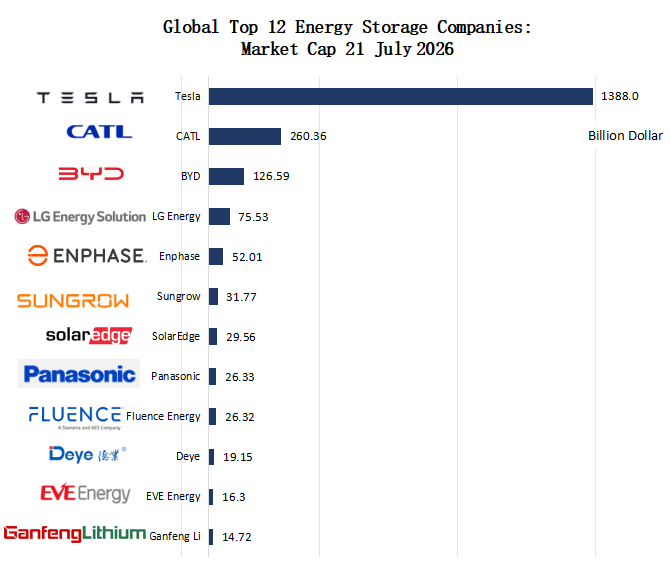
Tesla holds an unrivalled market capitalisation of USD 1.388 trillion, vastly exceeding second-placed CATL, which is valued at USD 260.36 billion. Tesla’s integrated manufacturing capacity for electric vehicle batteries, its global distribution networks for Powerwall and Megapack hardware, and the premium valuation of its solar-storage integrated ecosystem, set it apart from manufacturers solely focused on power cells. This leaves Tesla as the only trillion-dollar entity within the global energy storage space, with dominant market value exposure in both the residential and grid-scale overseas storage segments.
Chinese industry participants form the sector’s secondary valuation cluster, claiming half of all positions in the ranking. CATL and BYD secure the second and third global standings respectively, supported by scaled production of power and storage cells plus the deployment of large-scale storage assets worldwide. Meanwhile, Sungrow and Deye Electronics concentrate their operations on residential solar-storage power conversion system technology, and EVE Energy and Ganfeng Lithium specialise in storage cell production and upstream lithium feedstock development. Together, these enterprises cover the entire supply chain, from raw mineral extraction to cell manufacturing and power conversion hardware assembly. This establishes China as the primary supplier of global energy storage products.
International secondary operators are adopting niche specialisation strategies. For example, LG Energy Solution and Panasonic supply storage cells for overseas installations; Enphase and SolarEdge develop compact residential solar-storage solutions for the North American market; and Fluence Energy delivers integrated grid-scale storage systems. Although these companies have a lower individual market valuation than their leading Chinese counterparts, they have established distribution infrastructure and accredited grid compliance frameworks across Europe and North America, giving them entrenched regional advantages.
Valuation trends across the global energy storage market follow a consistent framework. Businesses that combine automotive manufacturing with storage ecosystem development attract substantial valuation premiums. Chinese operators occupy the mid-tier market capitalisation bracket thanks to comprehensive supply chain cost efficiencies and mass production capacity. In contrast, international competitors maintain targeted market footholds by serving niche, geographically defined sectors. This stratified competitive landscape within the global energy storage sector is set to become more entrenched over time.

Scan the QR code to follow PVTIME official account on Wechat for latest news on PV+ES