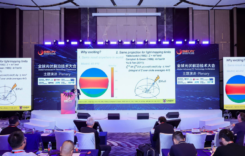

PVTIME – The 2026 World Artificial Intelligence Conference opened in Shanghai on 17 July. Huawei hosted a power industry summit, exploring how AI can be used to upgrade new power systems. Industry experts noted that AI has evolved from being merely an efficiency tool to becoming a core foundation for power sector production and operation. Huawei’s full-stack technologies are delivering measurable value to utility clients.
All stages of power generation, transmission, transformation, distribution and consumption are undergoing drastic changes. Key scenarios such as forecasting renewable output, predicting loads, performing predictive maintenance on equipment and simulating grids impose stringent reliability requirements on AI solutions.
Traditional power operation modes, which were supported by stable thermal and hydropower generation, have been overturned by the introduction of intermittent wind and solar power, as well as random electricity loads. AI is the key to rebuilding the entire source-grid-load-storage chain, overcoming obstacles such as the high proportion of renewable energy integration and the coordination of distributed energy to achieve comprehensive power intelligence upgrades.
Huawei adheres to a scenario-driven development approach and a three-pillar platform-plus-ecosystem strategy. The company is building open-source, secure and controllable computing foundations that comply with domestic information technology and security rules. It is also conducting joint innovation with power enterprises to integrate power operational logic and AI algorithms, and is fostering a complete industrial ecosystem with technology partners.
AI has evolved from L1 to L3–L4 in just three years, and enterprise agent architectures now support autonomous execution and iteration. Yao Jun, a Huawei AI systems scientist, commented that future agents will feature self-evolution, reasoning, closed-loop operation, and simulation functions. Huawei has deployed dozens of AI applications across the entire power industrial chain.
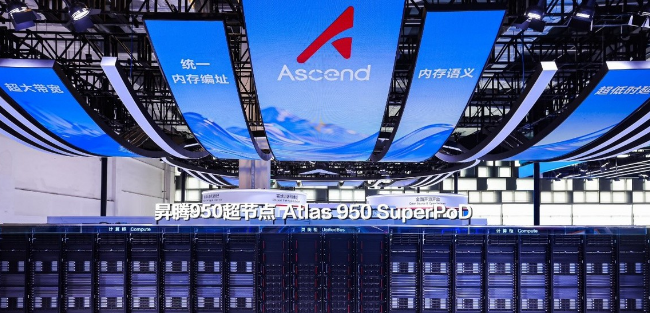
At WAIC 2026, the Atlas 950 SuperPoD was unveiled for the first time as the world’s largest supernode hardware. With 1024 cards, it provides 1 EFLOPS FP8 computing power, TB-level NPU interconnection bandwidth and a unified global virtual memory space of 256 TB, as well as merely 3 μs RTT latency, enabling massive concurrent AI training and inference.
With the support of computing hardware, AI models and an ecological layout, Huawei is empowering power firms to increase efficiency, boost revenue and mitigate risks in order to build modern energy systems. According to Zhou Yuefeng, Huawei will continue to increase investment in power AI. By relying on industrial large models, power cloud and Ascend computing, Huawei will collaborate with partners to develop scenario-based solutions and promote the large-scale deployment of AI in the power industry, accelerating the construction of new energy systems.

Scan the QR code to follow PVTIME official account on Wechat for latest news on PV+ES