
PVTIME – The New Zealand government is pursuing wide-ranging regulatory changes intended to lower solar photovoltaic installation costs and reduce assessment lead times. The aim is to deliver one of the most accessible residential and small-to-medium enterprise solar installation regimes across developed economies.
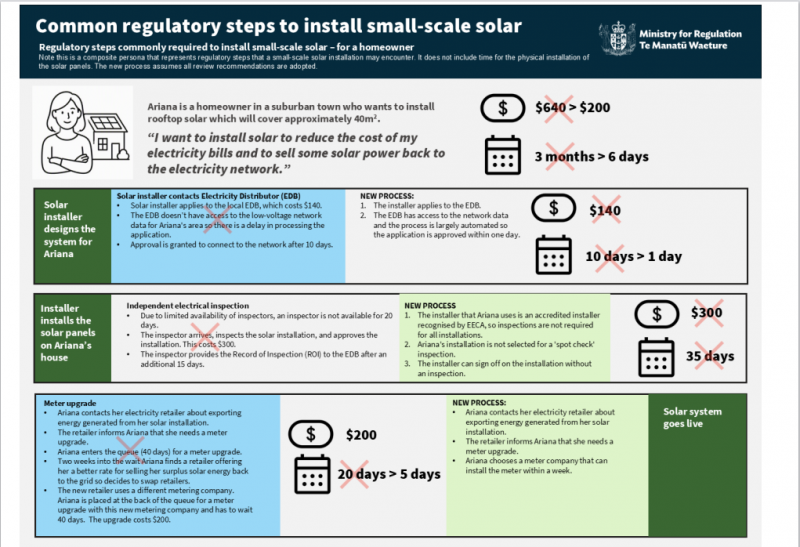
The proposals set out in the Ministry of Regulation’s July 2026 Improving the solar installation process report stem from a review initiated earlier in the year. The review found that existing procedures were burdened with bureaucratic overheads. Previously, certain PV installations required up to six signed documents and five site inspections from four separate bodies prior to activation. This administrative complexity increased project expenses, caused scheduling uncertainty, and deterred investment, leading to ministerial support for the recommended reform measures.
Approval fees and processing timescales will be substantially revised under the planned reforms. Residential solar PV application charges will fall from approximately NZ$640 to NZ$200, and assessment times will be reduced from three months to six days. For small-to-medium schemes, such as solar arrays on farm dairy sheds, maximum fees will drop from NZ$11,000 to NZ$1,300, and processing times will be reduced from six months to one month. Resource consent obligations will be removed for large installations, ground-mount solar plants, and developments within heritage or protected natural landscapes. This exemption is expected to deliver consumer savings of between NZ$3,000 and NZ$10,000, as well as reducing waiting periods by 30 days.
The legalisation of plug-and-play balcony solar is a key part of the package. David Seymour, the Minister for Regulation, has noted that similar systems are already permitted in Germany and the UK, and that New Zealand should allow them to be used, providing renters with the benefit of portable solar equipment. Network distribution companies will face tighter turnaround requirements for grid connection requests. Applications for systems below 10kW under the simplified route must be approved by the end of the next working day, while assessment periods for medium-sized projects will be reduced from over 30 working days to five.
The Ministry of Regulation forecasts net economic benefits of between NZ$28 million and NZ$50 million over the next 10 years, generated through reduced compliance burdens, fewer project delays and greater uptake of plug-and-play solar. However, the report identifies electricity market frameworks and modest feed-in tariffs as ongoing barriers to greater deployment. Stakeholders have also expressed concerns about restrictive retailer practices and limited power-supply options for end users.
According to independent analysis by Rewiring Aotearoa, New Zealand households could achieve annual savings of around NZ$3,000 by adopting electrified appliances, electric vehicles, rooftop solar PV and battery energy storage systems.

Scan the QR code to follow PVTIME official account on Wechat for latest news on PV+ES