
PVTIME – Late on 25 June, a missile hit the central warehouse of Atmosfera, Ukraine’s largest solar installation service provider, in Kyiv, sparking a large blaze that destroyed a substantial amount of photovoltaic equipment. The company provides businesses, municipal bodies and residential customers with PV, energy storage and integrated energy solutions. As no personnel were present at the site overnight, the attack caused no injuries.

The business activated its full emergency protocol immediately after the explosion. Staff relocated equipment and vehicles, redistributed stock across regional warehouses, and coordinated restocks with overseas manufacturers to minimise delivery delays for clients. This incident puts further strain on Ukraine’s renewable energy sector, which, according to a previous UN analysis, has already lost around 65% of its power generation infrastructure to military action.
The mass destruction of conventional central power plants has reshaped Ukraine’s entire energy framework. Large thermal facilities once powered entire cities, but now local communities rely heavily on small-scale, decentralised generation to sustain basic utilities. PV systems deliver critical backup power when the national grid fails.
Over the past two years, hospitals, schools, communication towers, commercial premises and homes have installed rooftop PV systems paired with battery storage, forming self-sufficient microgrids. Solar hardware is now considered vital energy infrastructure due to its growing wartime strategic importance.
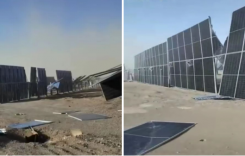
This attack on the warehouse is not an isolated case. Multiple solar assets across Ukraine have been subject to military strikes over the past twelve months. In 2025, a drone attack set a solar park in Odesa Oblast alight, forcing local critical infrastructure to switch to backup power. Solar facilities have also been severely damaged in other conflict zones, including residential solar arrays in Gaza and a 2MW solar plant in Yemen that was completely destroyed by airstrikes.
Unlike other conflict-affected markets, Ukraine continues to attract significant investment in renewable energy. The Polish solar firm ELQ has committed up to EUR 2.5 billion to develop a 2GW pipeline of solar and storage assets in the country. Its leadership has confirmed plans to begin reconstruction work without waiting for the conflict to end. Ukraine’s private energy operator, DTEK, has partnered with British organisations to launch the RISE programme, which will deliver 100 integrated solar-storage sites nationwide.
The International Energy Agency forecasts that Ukraine will require an additional 24GW of distributed PV power and 5.6GWh of battery storage by 2030 in order to establish a more secure, decentralised power network.
Four years of warfare have not halted the expansion of the national solar industry. According to figures from the Solar Energy Association of Ukraine, 1.5GW of new solar capacity was commissioned in 2025, almost doubling the total of 800MW in 2024, and cumulative installed solar capacity now exceeds 8.5GW. At the Munich Security Conference on 17 February, Ukraine’s foreign minister confirmed a USD 3.6 billion loan deal with China to fund three coal-fired power stations and one solar facility.
Ukraine’s energy storage import market is set to reach USD 4.2 billion by 2026, with storage equipment accounting for over 50% of this value, marking an 180% year-on-year increase. According to industry sales staff, 75% of the available local storage hardware is manufactured in China, alongside 85% of the available transformers and 76% of the available lithium batteries.
While wartime demand initially relied chiefly on international aid, commercial orders from energy and industrial firms now dominate procurement. Ukrainian projects feature compressed build timelines and fast-track delivery, alongside persistent logistics and safety risks from ongoing fighting. The market therefore presents strong commercial opportunities alongside elevated operational uncertainty for energy developers.

Scan the QR code to follow PVTIME official account on Wechat for latest news on PV+ES