

1. Overview:CATL Ranks Top 3 Globally in Wood Mackenzie’s Inaugural BESS Integrator Ranking
In 2025, global battery energy storage (BESS) installations crossed the historic 100 GW milestone, cementing the technology as a core pillar of modern power grids. Against this backdrop of market acceleration, Wood Mackenzie released its inaugural Global BESS Integrator Comprehensive Ranking. Designed as a rigorous benchmark for global procurement and financial due diligence, the evaluation awarded Contemporary Amperex Technology Co., Limited (CATL) its highest “Grade A” rating, placing the company third globally.
This ranking is far more than a milestone in market share; it demonstrates CATL has advanced beyond the role of battery manufacturer, establishing itself as a comprehensive, full-system solutions provider. This leap carries two major implications:
- Redefining Lifecycle Accountability: A true system integrator must guarantee the safety, economic viability, and operational stability of a multi-decade energy asset. Wood Mackenzie’s rating serves as the global market’s official endorsement of CATL’s comprehensive, full-lifecycle performance.
- Aligning with a Higher Standard of Global Due Diligence: As utility-scale projects scale to gigawatt levels, global buyers are pivoting away from comparing isolated technical parameters. Instead, they are prioritizing a partner’s engineering certainty and financial robustness. By seamlessly integrating proprietary cell innovation into a complete, system-level offering, CATL has cleared the industry’s most demanding procurement and bankability benchmarks, validating its vertical integration model on the global stage.
2. Recalibrating Global Standards: The Launch of the BESS “Michelin Guide”
As a definitive window into the evolution of the global energy storage landscape, Wood Mackenzie’s inaugural ranking evaluated 22 prominent BESS integrators across six countries, establishing a dynamic, annualized framework for assessing AC-coupled battery storage solutions. This assessment is far more than a routine industry ranking; it acts as the “Michelin Guide” for procurement, fundamentally reshaping the global criteria for selecting BESS partners.
2.1 An Industry Reimagined: From Initial Performance Parameters to Multi-Decade Certainty
As energy storage projects scale into the gigawatt-hour (GWh) realm and operational lifecycles span decades, BESS has evolved from a transactional equipment-purchase model into a critical, long-term infrastructure asset. This shift has fundamentally redrawn the decision-making playbook for global buyers:
- The Shift in Procurement Pain Points: Historically, buyers prioritized short-term, nameplate technical specifications such as capacity and round-trip efficiency. Today, utilities, independent power producers (IPPs), and developers are recalibrating their procurement filters to focus on a supplier’s long-term financial health, engineering capabilities, long-term service support, and overall execution certainty.
- Expert Analysis: Timothy Shen, Senior Solar Supply Chain Research Analyst at Wood Mackenzie, notes: “Battery energy storage is following the same evolutionary path as other critical infrastructure sectors. As projects scale and lifecycles stretch from years to decades, buyers are placing a premium on execution certainty. This has made financial robustness, engineering capability, and long-term service support just as critical as technical performance.”
2.2 Rigorous Criteria: Built on Real-World Buyer Due Diligence
- To ensure the ranking reflects actual market realities, Wood Mackenzie’s ranking criteria are built around the most asked questions by procurement teams during sourcing and supplier qualification. In this sense, the ranking provides a “Michelin Guide” style reference for global procurement—it does not just tell the market who is the best; it defines the benchmark for industry best practices.
- To comprehensively measure the multi-dimensional capabilities of system integrators, the framework evaluates suppliers across ten specific benchmarks, spanning technology maturity, research and development (R&D), safety, vertical integration, supply chain stability, adherence to ESG and CSR, and financial conditions.
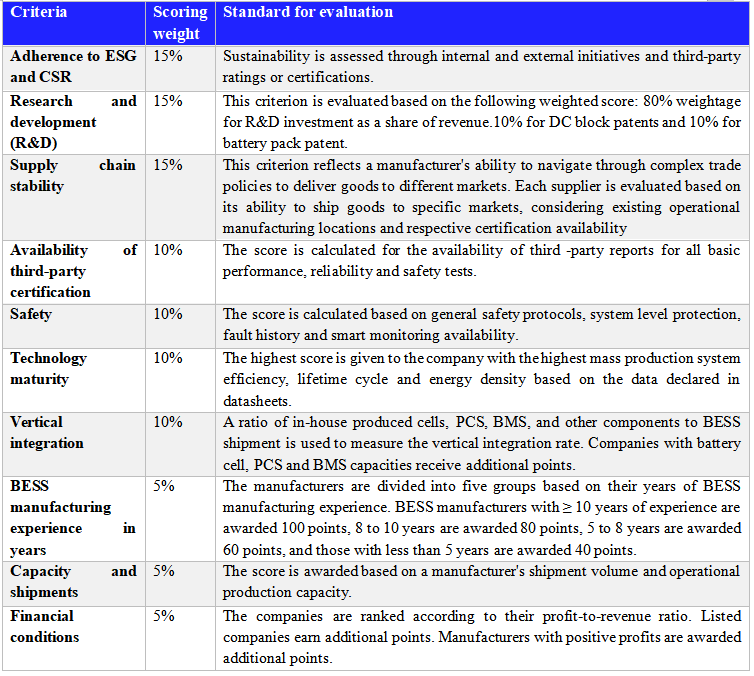
These ten benchmarks can be systematically categorized into three core dimensions: long-term corporate competitiveness, product capabilities, and commercial delivery capabilities.

3. Inside Grade A: CATL’s Strategic Leap Across Three Core Dimensions
CATL’s securing of a top-three global spot is not driven by an isolated parametric lead; rather, it is the cumulative result of systemic strengths seamlessly woven across all three core dimensions: long-term corporate competitiveness, product capabilities, and commercial delivery capabilities. Below is a detailed analysis of how these multidimensional strengths align with global standards.
3.1. Long-Term Corporate Competitiveness (50% Weight): Securing Certainty Across Market Cycles
Within the evaluation framework, “Long-Term Corporate Competitiveness”—the capacity to weather economic and policy cycles—accounts for a commanding 50% total weight, comprising R&D (15%), supply chain stability (15%), ESG (15%), and financial conditions (5%). This allocation indicates that the ranking transcends simple product comparisons, focusing instead on a vendor’s systemic capacity for continuous innovation, stable delivery, and compliance in long-cycle asset due diligence. CATL demonstrates verifiable and robust performance across all four pillars.
- R&D accounts for 15%, with a focus on R&D investment as a share of revenue and core patent portfolios. Backed by its 22,000+ R&D talents—including over 700 PhD holders—and supported by the 21C Innovation Laboratory, the National Engineering Research Center for Electrochemical Energy Storage Technology, the CNAS-accredited Testing and Validation Center, and the Future Energy Research Institute, CATL held 60,000 patents granted and pending to date. In the past decade, CATL’s R&D investment has exceeded RMB 100 billion—with more than RMB 20 billion invested last year alone. Driven by leading the industry in patent application growth for five consecutive years, achieving a cumulative grant rate of over 95%, and advancing its global IP layout, CATL was named one of Clarivate’s Top 100 Global Innovators. Furthermore, its project “Augmented Intelligence Leading Next-Generation Lithium-ion Battery Design” earned the World Economic Forum’s 2026 MINDS Award, establishing a global benchmark for AI-driven industrial applications.
- Supply Chain Stability also accounts for 15%, focusing on a company’s comprehensive ability to ensure stable delivery amid complex international trade environments — covering global manufacturing, export capabilities, localized production, international certifications, and adaptability to diverse markets. Wood Mackenzie notes that leading suppliers are expanding the global manufacturing scale to navigate trade policies and localization requirements. CATL is committed to building an efficient, resilient, innovative, and low-carbon supply chain. To strengthen the resilience of its upstream supply chain and secure critical resources for battery production, CATL has established a dedicated subsidiary focused on investment, operation and management in the new energy minerals sector. Through this subsidiary, CATL manages strategic investments in lithium, nickel, and phosphorus resources while expanding its global portfolio of high-quality mining assets. CATL also enhances resource security through battery recycling. In 2025, CATL recovered up to 210,000 tons of spent batteries and materials through efficient and environmentally responsible processes, regenerating 24,000 tons of lithium salts and further supporting a circular battery ecosystem.
- ESG carries a 15% weight in this system. For overseas energy storage projects, carbon footprint tracking and supply chain due diligence are becoming critical considerations in project financing and review. CATL maintains an MSCI ESG rating of AA, and its Yibin base has been certified by the World Economic Forum as the world’s first lithium‑ion battery plant to be recognized as a Sustainability Lighthouse, and the first and only one in the industry to be recognized for both productivity and sustainability. In addition, the company leverages its Carbon Chain Management System (CCMS) to enable end-to-end carbon data management from mineral resources to system integration, providing global project owners and financial institutions with clearer and more compliant pathways to green credentials. CATL is actively working with the Global Battery Alliance (GBA) on the Battery Passport initiative, which creates a digital twin for every battery, providing information on material sourcing, carbon footprint, and lifecycle sustainability. This helps build greater transparency and trust across the global battery value chain. We are also collaborating with partners such as BMW on pilot projects for cross-border battery data transfer under the Battery Passport scenario. We have also initiated Global Energy Circularity Commitment (GECC), working with the Ellen MacArthur Foundation to explore guidelines and standards of circular economy in the sector.
- Financial Condition carries a 5% weight, focusing on profitability, listing status, and financial robustness. The operation of energy storage assets over a decade or more, along with long-term after-sales and performance guarantees across market cycles, requires a sound financial foundation as a prerequisite. A Goldman Sachs research report notes that CATL is currently the only listed global battery company generating ROIC (Return on Invested Capital) above WACC (Weighted Average Cost of Capital). Its positive free cash flow generation provides global project owners with long-term asset security.
3. 2. Product Capability (30% weight): From Standalone Equipment to Premium Energy Assets
- Product capability is the critical vehicle through which a BESS evolves from standalone equipment to a premium energy asset. This dimension carries a combined weight of 30%, encompassing safety (10%), technology maturity (10%), and third-party Certification (10%). This indicates that the international market’s evaluation of energy storage systems has shifted from an early focus on energy density and conversion efficiency alone to a more comprehensive consideration of system safety, technology maturity, and third-party field validation.
- Safety accounts for 10%. BESS safety is not a simple physical integration of cells, but rather the comprehensive performance of a complex system. CATL has implemented multi-dimensional technologies that safeguard their products throughout their entire lifecycles. These technologies include intrinsic safety technology for cells, intelligent module safety control, systematic safety prevention and control, and the continuous iterative upgrading of digital, intelligent station-level safety management. Drawing on over 20 years of lithium-ion battery design experience and collaboration with institutes, CATL has developed a comprehensive quality management system specifically for energy storage. This system not only elevates battery quality to the DPPB (Defect Parts per Billion) level but also incorporates probabilistic safety assessment (PSA) techniques to evaluate system safety levels and quantify safety design standards. They have developed AI-driven TENER·SEES (Smart Electrical Energy Storage) platform with 99.99% fault prediction to ensure safety across diverse conditions.
- Technology Maturity accounts for 10%. This metric does not emphasize unproven technology concepts, but rather evaluates mature product capabilities that can withstand real-world operating conditions. In 2024, CATL launched the TENER energy storage system, achieving zero degradation in power and capacity for the first five years. This demonstrates that CATL BESS does not remain at the level of theoretical parameters, but translates technological capability into deliverable, operable systems that can support project returns. CATL unveiled the world’s first field-validated sodium-ion BESS at this year’s Intersolar, marking a major step toward the commercial deployment of sodium-ion energy storage.
- Third-party Certification accounts for 10%. The reliability of energy storage systems cannot rely solely on a company’s unilateral claims; it must withstand the scrutiny of international standards systems. This aligns closely with CATL’s “real-world validated energy storage” approach — proactively moving validation earlier in the process and shifting the validation subject from individual components to the entire station. Leveraging the Xiamen Energy Storage Validation Research Institute (ESVL), CATL is collaborating with international institutions including TÜV SÜD and TÜV Rheinland to drive the development of station-level validation standards, reducing the uncertainty in the industry caused by a lack of empirical evidence.
3.3 Commercial Delivery Capability (20% weight): Critical Enabler for Global Deployment
Commercial delivery capability is a critical prerequisite that determines whether BESS can be deployed in large-scale global projects. The 20% weight indicates that global developers and grid clients are not only concerned with the product itself, but also with whether a supplier can form a complete delivery loop encompassing R&D, manufacturing, system integration, and long-term service.
- Vertical Integration accounts for 10%, primarily examining a company’s in-house manufacturing and system integration capabilities across cells, PCS, BMS, and other core components. Wood Mackenzie notes that all top ten global companies produce at least one critical component; higher levels of value chain control help improve product compatibility, strengthen quality control, and reduce delivery risks for large-scale, complex energy storage projects.
CATL has built vertical capabilities spanning energy storage cells, BMS, battery packs, and system integration, and leverages technologies such as CTP and liquid-cooling thermal management to achieve coordinated design across battery, fire protection, cooling, and control subsystems. This closed-loop capability from core components to system-level products helps improve product consistency and system matching, providing support for GWh-scale project delivery and long-term stable operation.
- Manufacturing Experience and Capacity & Shipment each account for 5%, focusing on BESS manufacturing experience and delivery capability. As early as 2011, CATL participated in the Zhangbei energy storage demonstration project. The relevant products have maintained a zero-accident record for over a decade of operation. As of 2019, the system’s State of Health (SOH) reached 93%, with annual degradation of less than 1% and a round-trip efficiency of 90.3% — using real operational data to substantiate long-term reliability.
While manufacturing experience is important, Wood Mackenzie did not assign it a decisive weight. CATL did not start as a traditional energy storage system integrator; rather, it has progressively extended its capabilities from cells and battery systems toward comprehensive BESS solutions. CATL BESS ranked third globally in Wood Mackenzie’s inaugural comprehensive ranking. This demonstrates that the international market looks not only at how long a company has been active in system integration, but more critically at whether it can translate its foundational technological accumulation into system-level products, scalable delivery, and long-term service capabilities.
Taken together, the core logic behind CATL’s Grade A rating lies in its transition from a “battery supplier” to a “system solutions provider.” What the international market recognizes is a globally competitive BESS supplier. Looking ahead, for long-cycle energy storage assets, reliability is not just a promise — it is a system-level asset capability that is real-world validated, procurable, bankable, and worthy of long-term trust.
4. Conclusion: From “Equipment Supplier” to “Full-Lifecycle Asset Partner”
From Wood Mackenzie’s Inaugural BESS Integrator Ranking, the core logic behind CATL’s Grade A rating and its top-three global ranking lies in its ongoing transition from a “battery supplier” to a “system solutions provider.”
The significance of this transformation extends beyond a change in product portfolio — it represents a fundamental shift in role positioning. A cell supplier is only responsible for the performance and quality of the cells themselves; a system solutions provider, however, must take responsibility for the performance of the entire energy storage asset across its full lifecycle — from upfront system design and midstream engineering delivery to downstream operations and maintenance support — with every link in the value chain playing a critical role. Wood Mackenzie’s ranking clearly demonstrates that this transition has been recognized and endorsed by an internationally authoritative evaluation system.
For long-cycle energy storage assets, reliability is not just a promise. It must be real-world validated —standing up to third-party certification and real-world operational data; procurable — meeting the supplier screening standards of leading global developers and EPCs; bankable — satisfying financial institutions’ requirements for project asset security; trusted over the long term — consistently delivering on performance commitments over 10- or 20-year operating cycles. This is the true industry essence revealed by Wood Mackenzie’s inaugural BESS comprehensive ranking.
What the international market recognizes is not the battery manufacturer with the largest shipment volume, but a globally competitive BESS system solutions provider — a reliable partner capable of sharing the responsibility for long-cycle asset operations with global developers and asset owners. This is perhaps the most important takeaway this ranking offers to the entire energy storage industry.

 installations crossed the historic 100 GW milestone, cementing the technology…)