
PVTIME – The global photovoltaic module sector is experiencing a significant reshaping of its competitive landscape. Leading manufacturers are strengthening their market position by leveraging their brand equity, technological development, large-scale production capabilities, and well-established distribution networks. Currently, most top-tier players record approximately half of their total shipment volumes, measured by capacity, from overseas markets. Meanwhile, second- and third-tier suppliers are under increasing pressure in terms of order acquisition, capacity utilisation and profit margins, which is widening the performance gap between market participants. Consequently, shifts in market share, tender performance, technology roadmaps and operational strategy have become key indicators for tracking the evolving dynamics of the PV industry.
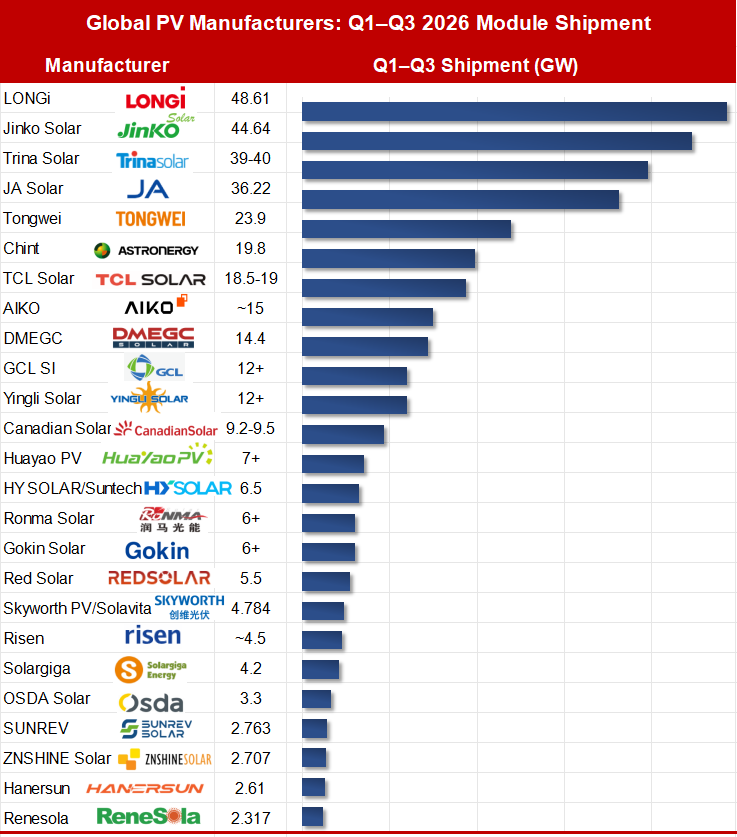
Chart notes: JA Solar’s Q1–Q3 shipment figure includes a small volume of solar cells which cannot be separated without disrupting the ranking. All other listed volumes exclude cell shipments. TCL Solar’s figure incorporates supply to other entities within the TCL group and sales from its overseas affiliate, Maxeon. Suntech is a brand of HY SOLAR. Solavita is the manufacturing subsidiary of Skyworth PV.
This dataset is not intended for investment or procurement decisions. Where discrepancies exist, official company announcements take precedence.
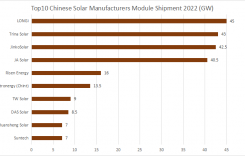
LONGi held the top position in 2026, with module shipments reaching 48.61GW across the first three quarters. Its shipments of back-contact modules reached 31.64GW, representing over 65% of its total module volume. There was notable growth in uptake across overseas and distributed generation markets.
With 44.64GW of module shipments, Jinko Solar ranks second. The company holds a leading position in both overseas sales and the deployment of high-efficiency products. Its Tiger Pro 3 modules accounted for over a third of its shipments in the third quarter, demonstrating the popularity of its premium product range.
Trina Solar sits in third place, with shipments of approximately 39–40GW. The company has been a prominent advocate of national standard tiered bidding frameworks for module procurement, a policy designed to preserve price premiums for high-efficiency TOPCon modules in tender markets.
JA Solar takes fourth place, having shipped a total of 36.22GW of modules and cells. The top four manufacturers together command an aggregate market share of around 48%. JA Solar’s proportion of overseas shipments stands at 60.92%, highlighting its strategic expansion into international markets to capitalise on improved margin opportunities.
Tongwei Solar is in fifth place, having shipped 23.9GW of modules. Around two thirds of its sales are delivered within China, which improves its position in China-only shipment rankings.
Astronergy, Chint’s PV division, ranks sixth with shipments totalling 19.8GW. Its overseas sales ratio exceeds 40%, reflecting its consistent progress in expanding into the international market over multiple years.
TCL Solar is in seventh place, with a group-wide shipment volume of 18.5–19GW, close to Astronergy’s total. Of the top ten manufacturers, it has the highest proportion of sales within China and has a strong track record of securing volumes through central and state-owned utility tender programmes.
AIKO ranks eighth, having shipped roughly 15GW. It is the only major manufacturer in this group to sell exclusively back-contact modules. Beyond the highly competitive European market, it has established a significant market presence in Australia.
DMEGC is in ninth place with 14.4GW. More than two thirds of its shipments are destined for overseas markets, although the company has recently increased its participation in tender processes run by China’s central power enterprises, thus maintaining an active domestic presence.
GCL SI and Yingli Solar share tenth place, with shipment volumes above 12GW. The two firms follow distinct strategic paths. GCL SI has taken a more assertive approach to China’s tender market, delivering stronger volumes in this segment. By contrast, Yingli Solar leverages its long-standing global brand recognition to secure sustained demand from international buyers.
The divergence between top-tier and mid-tier suppliers reveals a maturing market structure. Maintaining profitability increasingly hinges on scale and high-efficiency product portfolios, while access to diversified overseas demand acts as a buffer against the more competitive pricing environment within China. As premium technologies such as back-contact and advanced TOPCon modules gain market acceptance, tender design and regional market access will continue to influence how value is created throughout the global PV supply chain.
This layered set of results also indicates that achieving resilient margins now requires more than just pure scale. Manufacturers must strike a balance between volume growth and targeted geographic positioning, as well as achieving clear technology differentiation. While firms heavily invested in China’s tender market benefit from steady order pipelines, they remain exposed to intense downward pressure on pricing. Businesses with a broad international presence can access higher-value markets, but must navigate evolving import rules, local content requirements, and supply chain logistics risks in different regions. Looking ahead, the distinction between successful companies and those that are struggling will become more pronounced, as capital will flow towards producers that can align their product technology, regional sales mix and tender strategy to match the varied requirements of global renewable energy buyers.