
PVTIME – Patent disputes have long been a feature of the solar photovoltaic sector, but the structure, geographic focus and core arguments of these legal battles underwent a fundamental transformation between 2025 and 2026. What began as largely domestic litigation between Chinese PV manufacturers evolved into cross-border legal action targeting market access, patent validity, and manufacturing equipment. This has created tangible commercial risks extending far beyond cell and module producers to project buyers, developers, and EPC contractors.
In 2025, patent conflicts were dominated by disputes among Chinese solar manufacturers. Well-known companies such as JinkoSolar, Trina Solar and Canadian Solar brought forward infringement claims across jurisdictions, including China, the United States, Japan, Australia and Europe. The litigation centred primarily on allegations of copied manufacturing methods and involved record-high claim values: for example, Trina Solar pursued around US$134 million in damages from Canadian Solar in one case. The core question in nearly all of these lawsuits was whether a rival manufacturer had unlawfully replicated patented production processes. Many of these intra-industry conflicts were resolved through licensing agreements by early 2026, bringing this first phase of the patent wars to a close.
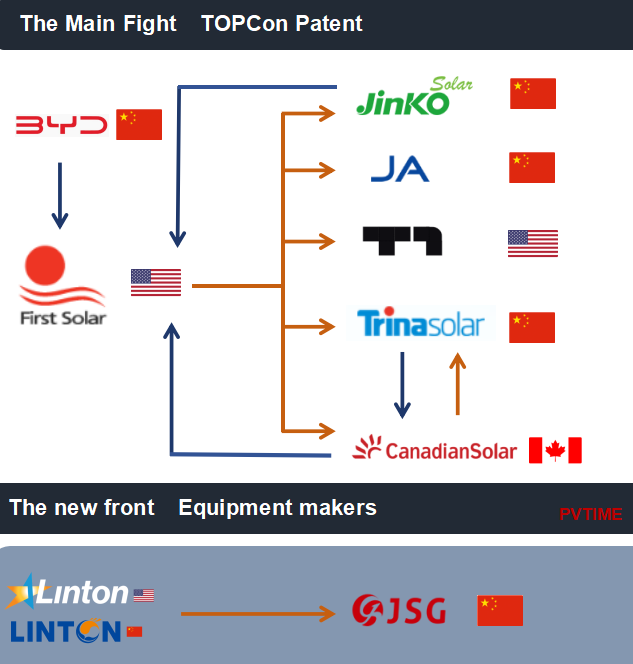
By October 2026, the centre of gravity for PV patent litigation had decisively moved to the US market, with a clear change in the identity of the main claimants. First Solar, a US-based PV manufacturer that does not produce TOPCon panels, emerged as the key plaintiff in TOPCon cell patent litigation. First Solar acquired relevant TOPCon intellectual property when it purchased TetraSun in 2013, and it has since amended its patent claims. The company has initiated infringement proceedings against several TOPCon producers, including JinkoSolar, Trina Solar, T1 Energy, and JA Solar, as well as its US distributor, American Panel Solutions.
Unlike earlier disputes driven by competition over direct product sales, First Solar’s strategy has two objectives: securing licensing revenue and slowing the flow of competing imported TOPCon hardware into the US market rather than solely capturing a greater share of the module market itself. The defendants are pushing back vigorously. JinkoSolar and Canadian Solar have challenged the validity of First Solar’s patents, and the Chinese version of one key patent was cancelled in May 2026. Canadian Solar has also filed a countersuit and secured the cancellation of US patents related to Trina Solar. This marks a critical shift in legal tactics. While 2025 cases focused on proving infringement, 2026 litigation places patent validity at the heart of the dispute. Companies are now actively seeking to invalidate their opponents’ patents, adding a second layer of complexity to each dispute.
A second major new front has opened outside of solar cell technology, within the solar manufacturing equipment sector. US-headquartered Linton Crystal, which is owned by China’s Liancheng NC, has launched legal action against Jingsheng for allegedly copying furnace patents and is seeking to block the import of relevant machinery into the US. Linton Crystal has also initiated separate patent action against NextPower concerning solar tracker mounting hardware, which is distinct from PV panels. This expansion means that patent risk is no longer confined to finished cells and modules, but now extends to the production tools used to manufacture solar hardware.
These evolving legal battles have significant consequences for solar asset buyers, developers, and EPC firms, and are not just an issue for panel manufacturers. Court injunctions or import bans can halt product shipments mid-project. This can delay the start of commercial operations (COD), trigger liquidated damages and expose project owners to obligations under power purchase agreements. Importing a product deemed to infringe intellectual property rights can create direct liability for the importer of record, rather than only for the original manufacturer.
Warranty arrangements spanning 25 to 30 years also carry long-term exposure. If patent damages or licence fees arise decades after panel installation, the supplier must have the financial means to meet these obligations. Licensing costs and settlement payments absorbed by manufacturers upstream may also be passed down and reflected in the final project price.
For parties signing procurement contracts, due diligence is now essential. Stakeholders must examine patent indemnity clauses and the underlying licensing rights for solar cells, particularly for shipments destined for the US market. Contract terms should clearly allocate responsibility in the event that a court order stops product delivery. While hardware that has already been delivered and installed is generally not at risk of being removed, buyers must still assess future delivery exposure, schedule risk, and cost allocation in the event of patent challenges.
Despite the changing litigation landscape, several core features of this market risk have remained consistent. The financial burden of patent disputes ultimately falls on buyers. As early as 2025, lenders began requiring robust patent indemnity clauses, while EPCs incorporated contingency pricing to account for patent litigation risks. These market practices have remained unchanged since then.
The evolution of PV patent litigation indicates a wider shift in risk throughout the entire solar supply chain. Legal disputes have moved beyond manufacturer-versus-manufacturer battles over copied cell production techniques. They now encompass upstream manufacturing equipment, cross-border challenges to patent validity and US import controls, creating multi-layered commercial risks for all participants in the PV value chain.
This analysis draws on information from PV Tech, pv magazine, Reuters, filings from the US International Trade Commission, the China IP Law Blog, and corporate statements as of 8 October 2026. It does not constitute legal advice.