
PVTIME – InfoLink Consulting has published its regional shipment assessment for the global residential energy storage sector for the first half of 2026. Based on the firm’s proprietary global residential storage shipment database, the analysis quantifies manufacturers’ delivery performance in different geographic markets.
Global residential energy storage shipments reached 39.07GWh in the first half of 2026, representing year-on-year growth of 137.67%. The world’s top five suppliers by total shipment volume are Fox ESS, Sigenergy, Deye, Huawei and GoodWe, with full regional rankings detailed below.
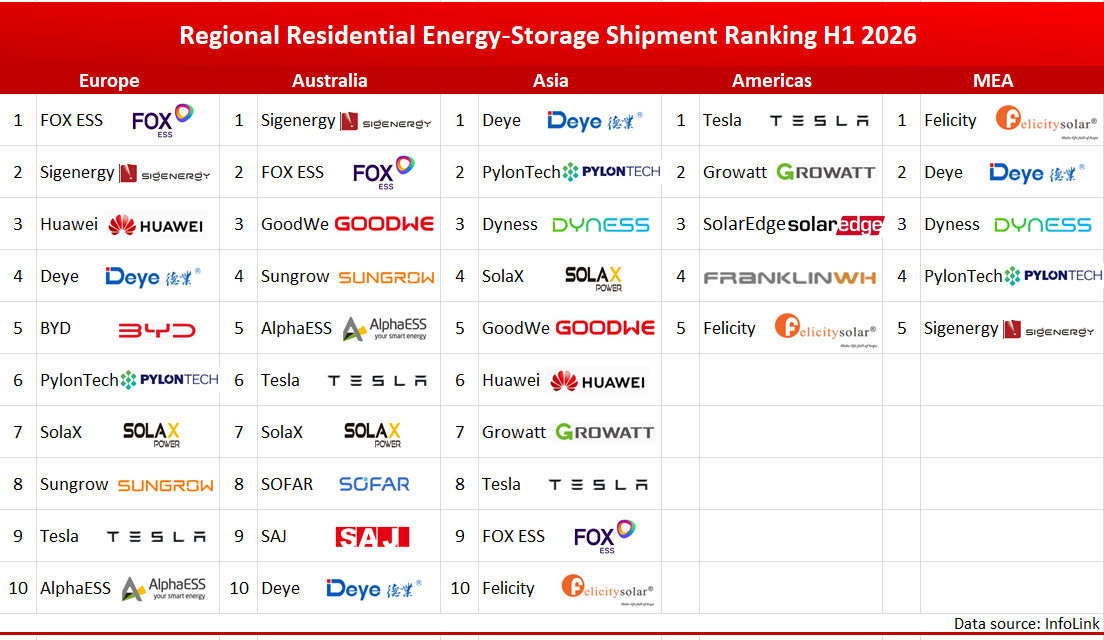
Europe achieved 15.25GWh of residential energy storage system shipments in the first half of 2026. Fox ESS, Sigenergy, Huawei, Deye and BYD Energy Storage are the region’s top five vendors. Incumbent suppliers Huawei and BYD maintain a strong market position in key territories such as Germany and Italy. Fox ESS and Sigenergy have achieved higher overall shipment volumes by expanding into emerging western, northern and eastern European markets. Deye secured its top-five regional position thanks to solid commercial traction in Eastern Europe, particularly in Ukraine.
The European residential storage market is showing signs of year-on-year recovery. This growth is driven by geopolitical influences on fossil fuel prices and favourable policy adjustments in countries such as the United Kingdom, Hungary, Poland and the Netherlands. These adjustments include residential storage subsidies and the phase-out of solar net metering. The majority of these subsidy schemes are not yet available for large-scale applications, but access is expected to open in Q3 and Q4 of 2026. Continued market expansion and recovery are forecast for Europe throughout the second half of 2026 and 2027.
Oceania recorded residential energy‑storage system shipments of 10.03GWh for H1 2026, with Sigenergy, Fox ESS, GoodWe, Sungrow and AlphaESS ranking as the region’s top five suppliers.
Sigenergy, Fox ESS and GoodWe dominate the market as the three main competitors. Their combined market share has overtaken that of long-standing Australian residential storage incumbents, including Sungrow, Tesla and AlphaESS. Intense rivalry between these three companies has led to frequent price competition.
Australia’s residential storage installation volumes fell markedly between May and July following the phase-down of local subsidy support on 1 May 2026. Demand was front-loaded in the first half of the year, drawing down much of 2026’s total market potential and pointing to a substantial contraction in Australia’s residential storage sector in the second half of the year.
Asia registered residential energy storage system shipments of 6.27GWh during H1 2026. The region’s top five operational suppliers are Deye, PylonTech, Dyness, SolaX Power and GoodWe. The Asian residential storage market, which covers South Asia, Southeast Asia, Japan and South Korea, centres on key economies including Pakistan, Vietnam and the Philippines, where frequent power outages and high residential electricity rates drive robust demand for backup power. Deye has a substantial market share in the region thanks to its early market entry and targeted product positioning. Other key players, including PylonTech, Dyness, SolaX Power and GoodWe, have expanded their regional presence by launching cost-effective product lines tailored to local market needs and have achieved consistent growth in their respective market shares as a result.
The Americas achieved residential energy storage system shipments of 3.52GWh in the first half of 2026, with Tesla, Growatt, SolarEdge, FranklinWH and Felicity securing the top five regional market positions. The United States is the region’s main residential storage market and has traditionally been dominated by local Western manufacturers, including Tesla, SolarEdge and Enphase. Although Tesla maintained a substantial lead in the market throughout the first half of 2026, select Chinese manufacturers, including Growatt and FranklinWH, increased their market share through key client partnerships and localised brand development strategies. The Latin American market remains relatively small, but targeted expansion into niche territories such as the Dominican Republic and Chile has enabled Felicity to rank among the top five residential storage vendors in the Americas.
The Middle East and Africa region recorded residential energy storage shipments totalling 3.82GWh in the first half of 2026. The region’s top five suppliers are Felicity, Deye, Dyness, PylonTech and Sigenergy. Felicity and Deye dominate the regional market landscape. Felicity has achieved robust growth by focusing on the off-grid and hybrid power markets in Kenya, Uganda, and other price-sensitive regions in Africa. Deye’s regional success is fuelled by robust sales in major African markets such as South Africa and Nigeria, as well as increasing deployment volumes across the Middle East. Ongoing instability and inadequate public power infrastructure in Iraq, Syria and Lebanon have generated a steady demand for residential energy storage for emergency backup power.
The global residential energy storage landscape is set to undergo a structural shift in the H2 of 2026, driven by changes in regional policies and market dynamics. The reduction of Australian subsidies and the progressive implementation of favourable policies in Europe will shift global market momentum towards the continent. Although the markets in Asia, Latin America, the Middle East and Africa are currently modest in scale, their low levels of solar and storage penetration offer considerable untapped growth potential. However, rising geopolitical tensions and local market barriers continue to expose Chinese manufacturers to high operational uncertainty in the US market.
Competition in the global market continues to escalate across all regions. Even in mature markets with seemingly stable patterns, the emergence of capable new vendors is consistently reshaping industry rankings. The rapid growth of new market entrants demonstrates that bespoke product design adapted to regional demand and accurate local channel layout have become definitive core competencies, enabling enterprises to consolidate their market positions and stand out amid intensifying industry rivalry.