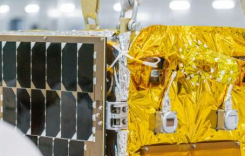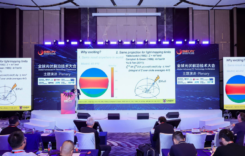

PVTIME – On 22 March 2026, Elon Musk officially unveiled SpaceX’s AI-powered orbital computing satellites at the launch event for the Terafab superchip factory. Each miniaturised satellite features a 100 kW power system, with solar arrays that extend to almost 170 metres when fully deployed. This is sufficient to support the full-load operation of around 100 NVIDIA H200 units.
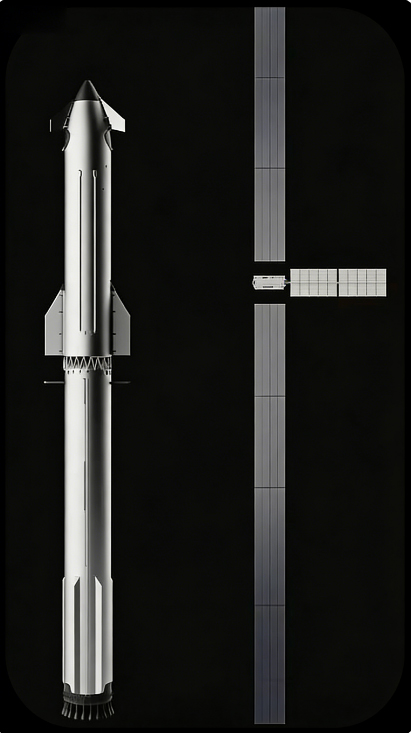
Picture: SpaceX
Musk’s long-term plan is to deploy 10 million of these satellites, with power outputs moving towards the megawatt range. This will create exponential demand for high-power, lightweight, radiation-resistant photovoltaic cells. This is 10 times the power output of a Starlink V2 mini satellite and 3.5 times that of a traditional Jupiter 3 communications satellite.
A constellation of 10 million satellites would deliver hundreds of gigawatts of on-orbit capacity. Traditional gallium arsenide solar cells are hampered by high costs and limited production capacity, making them unsuitable for large-scale deployment. This makes P-type HJT the optimal medium-to-short-term solution.
Chinese HJT solar cells currently support the mass production of ultra-thin 50–70 µm wafers, offering significant weight reduction and excellent radiation resistance, as well as a cost of approximately one-tenth that of conventional space solar cells. These cells are ideally suited to large-scale low Earth orbit constellations.
SpaceX has confirmed its preference for the P-type HJT approach. China holds global dominance in HJT turnkey production lines, ultra-thin wafers, high-efficiency solar cells, and aerospace-grade encapsulation materials. The country also boasts robust rapid scaling and stable delivery capabilities.
According to industry sources, the intensive launches of SpaceX and global low Earth orbit constellations are increasing demand for HJT equipment, ultra-thin wafers, radiation-resistant adhesive films and CPI flexible encapsulants. Over 10 billion RMB worth of equipment purchases have already been secured, with continuous orders being released throughout the industrial chain. China’s integrated system of high-efficiency solar cells, ultra-thin wafers, and aerospace materials is setting the global standard for space photovoltaics and securing its position as a leader in future space energy.

Scan the QR code to follow PVTIME official account on Wechat for latest news on PV+ES