
PVTIME – On 4 March, researchers from Shenzhen Technology University, Soochow University, and the Hong Kong Polytechnic University announced a significant breakthrough in the leading international energy journal, Energy & Environmental Science. The team, led by Professor Cheng Huiming and Associate Professor Bai Yang of Shenzhen Technology University in collaboration with Professors Zhang Xiaohong and Yang Xinbo, as well as Assistant Professor Yang Guang, has developed a thermodynamic stabilisation strategy that addresses the core stability challenge of photo-induced phase separation in wide-bandgap perovskites.
This innovative method suppresses the preferential nucleation of bromine-rich phases at the thermodynamic level, overcoming a critical barrier to the commercialisation of perovskite photovoltaic technology. Wide-bandgap perovskites are a key material for the top cell of tandem solar cells, but they commonly experience halide phase separation when exposed to light and heat, which leads to a significant decline in performance. Traditional approaches have relied on post-treatment methods such as defect passivation and lattice adjustment, but these fail to address the fundamental cause of the problem.
The research team identified uneven nucleation during the initial film formation process as the root of the problem. Bromine-rich phases with more negative formation energies tend to precipitate first, creating compositional inhomogeneity that worsens under external stress. The team introduced potassium thiocyanate to deliver proactive thermodynamic control. During nucleation, potassium ions increase the energy barrier for bromine-rich phases and encourage the uniform co-nucleation of iodine and bromine. At grain boundaries, thiocyanate ions form a two-dimensional in-situ perovskite barrier that restricts halide ion migration.
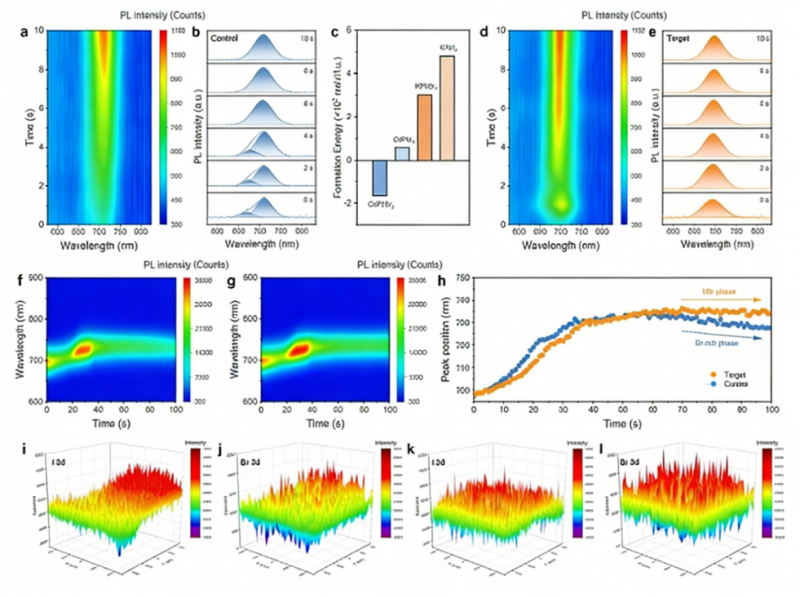
a) In-situ PL images of the perovskite in the control group during the spin-coating process; b) PL curves extracted from a); c) Calculated formation energies of the perovskite; d) In-situ PL images of the perovskite in the target group during the spin-coating process; e) PL curves extracted from d); f) In-situ PL images of the perovskite in the control group during the annealing process; g) In-situ PL images of the perovskite in the target group during the annealing process; h) Peak position-time curves extracted from f) and g); i) XPS distribution map of iodine in the control group film; j) XPS distribution map of bromine in the control group film; k) XPS distribution map of iodine in the target group film; l) XPS distribution map of bromine in the target group film.
Performance testing confirmed the effectiveness of the strategy. A single-junction perovskite solar cell with a wide-bandgap of 1.68 eV achieved a conversion efficiency of 23.50% with reduced voltage loss. The corresponding perovskite/silicon tandem cell reached an efficiency of 33.08%, with a certified value of 32.52%. After 2,240 hours of continuous operation, the single-junction device maintained 98% of its initial efficiency. The projected T90 lifetime of the tandem cell exceeds 9,700 hours, and it operated stably for over 540 hours in challenging outdoor conditions.
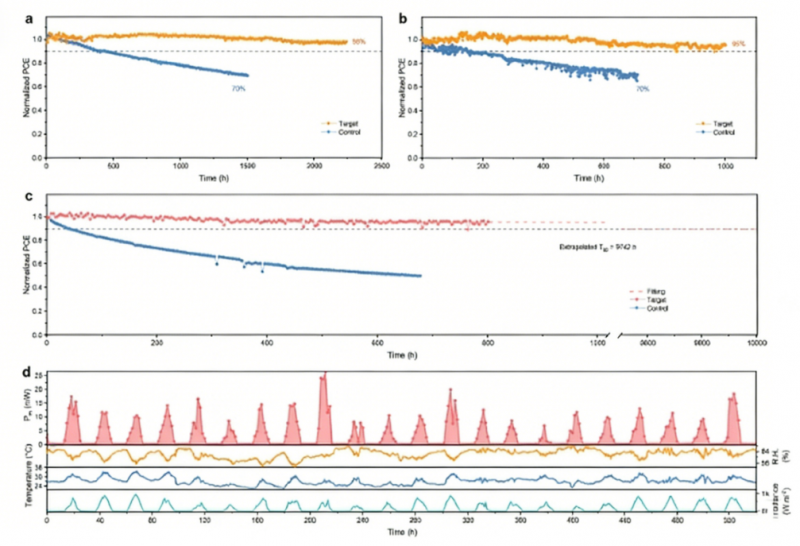
a) Long-term MPPT of 1.68 eV single-junction perovskite solar cells from the control and target groups under 1-sun illumination, in compliance with the ISOS-L-1 standard; b) Long-term MPPT of 1.68 eV single-junction perovskite solar cells from the control and target groups under 1-sun illumination, in compliance with the ISOS-L-2 standard; c) Long-term MPPT of perovskite/silicon tandem solar cells from the control and target groups under 1-sun illumination, in compliance with the ISOS-L-1 standard; d) Outdoor power output of encapsulated perovskite/silicon tandem solar cells in real-world environments, in compliance with the ISOS-O-2 standard.
This strategy can be applied to a range of wider-bandgap systems, including 1.77 eV and 1.88 eV variants. It has enabled the development of all-perovskite tandem cells with an efficiency of 28.18%, certified at 28.17%, as well as perovskite/organic tandem cells with an efficiency of 25.66%, both of which exhibit significantly improved phase stability.
This discovery reveals the fundamental nucleation mechanism behind compositional inhomogeneity and establishes a new approach to proactive thermodynamic regulation. This work showcases Shenzhen Technology University’s capabilities in advanced research, spanning from fundamental materials science to the development of high-performance devices, and offers a vital technical pathway for the industrial implementation of efficient and stable perovskite-based tandem photovoltaic technologies.

Scan the QR code to follow PVTIME official account on Wechat for latest news on PV+ES