

PVTIME – Researchers from the Indian Institute of Technology Bombay have developed transparent four-terminal (4T) perovskite solar cells that achieve an overall efficiency of 28.4% to 30.2% when integrated into mechanically stacked tandem devices with an n-TOPCon bottom cell. The breakthrough relies on an ion-modulated spiro-MeOTAD hole transport layer (HTL) that enhances performance and stability while enabling compatibility with varying perovskite compositions.
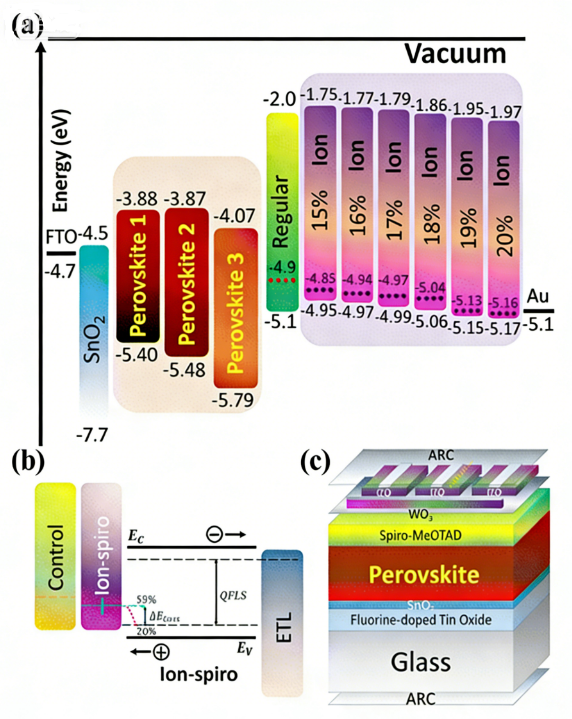
The ion-modulated HTL is designed to passivate interface defects, improve carrier dynamics and allow tunable work functions for wide-bandgap perovskites. The product has been shown to suppress interface recombination, boost photoluminescence quantum yield and enhance quasi-Fermi level splitting. This delivers significant improvements in open-circuit voltage and fill factor across three different perovskite compositions, regardless of bandgap.
Dinesh Kabra, the study’s lead author, explained that the HTL eliminates the need for bandgap-specific engineering, thereby mitigating halide segregation, a key limitation of wide-bandgap perovskites in tandem photovoltaics. This approach decouples transport layer compatibility from absorber composition, allowing perovskite formulations to be selected based on intrinsic stability and optoelectronic quality rather than interface constraints.
The research, which was published in the Royal Society of Chemistry, details how the ion-modulated spiro-MeOTAD HTL is optimised using 4-tert-butyl-1-methylpyridinium bis(trifluoromethanesulfonyl)imide (TBMPTFSI) salt. This method offers a simpler, more controllable approach to energy level alignment than molecular structure engineering, reducing interface defects and improving stability.
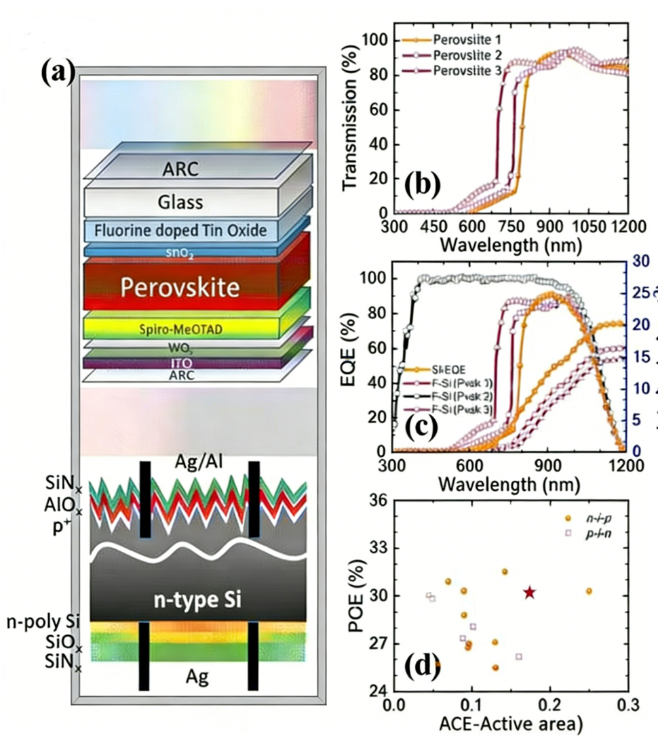
The tandem device features a glass-substrate top perovskite cell with a tin dioxide (SnO₂) electron transport layer, a perovskite absorber, a spiro-MeOTAD HTL, an indium zinc oxide (IZO) top transparent electrode and a silver (Ag) metal grid. Optimisation of the TBMPTFSI concentration between 15% and 20%, along with precise adjustment of the HTL spin-coating speed, further enhanced efficiency and performance.
Testing confirmed the tandem configuration’s efficiency of up to 30.2% when coupled with commercial n-TOPCon silicon cells. External quantum efficiency, transmittance and integrated JSC measurements were aligned with J–V and optical analysis, validating performance improvements. Stability tests under high temperature, continuous illumination and maximum power point tracking have also demonstrated enhanced robustness, consistent with reduced interface defects.
Kabra noted the ion-modulated spiro-MeOTAD with optimised work function significantly enhances surface defect tolerance, improving open-circuit voltage by 2–5% and fill factor by 6–7%. These findings redefine tandem device design principles and provide a scalable pathway to commercially viable, stable and efficient perovskite-silicon photovoltaics for next-generation solar technology.

Scan the QR code to follow PVTIME official account on Wechat for latest news on PV+ES







 perovskite solar cells that achieve an overall efficiency of 28.4% to 30.2% when integrated into…)