
PVTIME – The BloombergNEF Tier 1 ranking of photovoltaic module manufacturers, ordered by their annual production capacity for Q3 2026, provides a clear overview of the global solar manufacturing landscape. It highlights market consolidation and regional diversification, as well as the continued dominance of large-scale Asian producers. Importantly, the Tier 1 designation evaluates manufacturer bankability rather than the technical quality of individual solar modules, a distinction that is crucial for project financiers, developers, and energy stakeholders in international renewable markets.
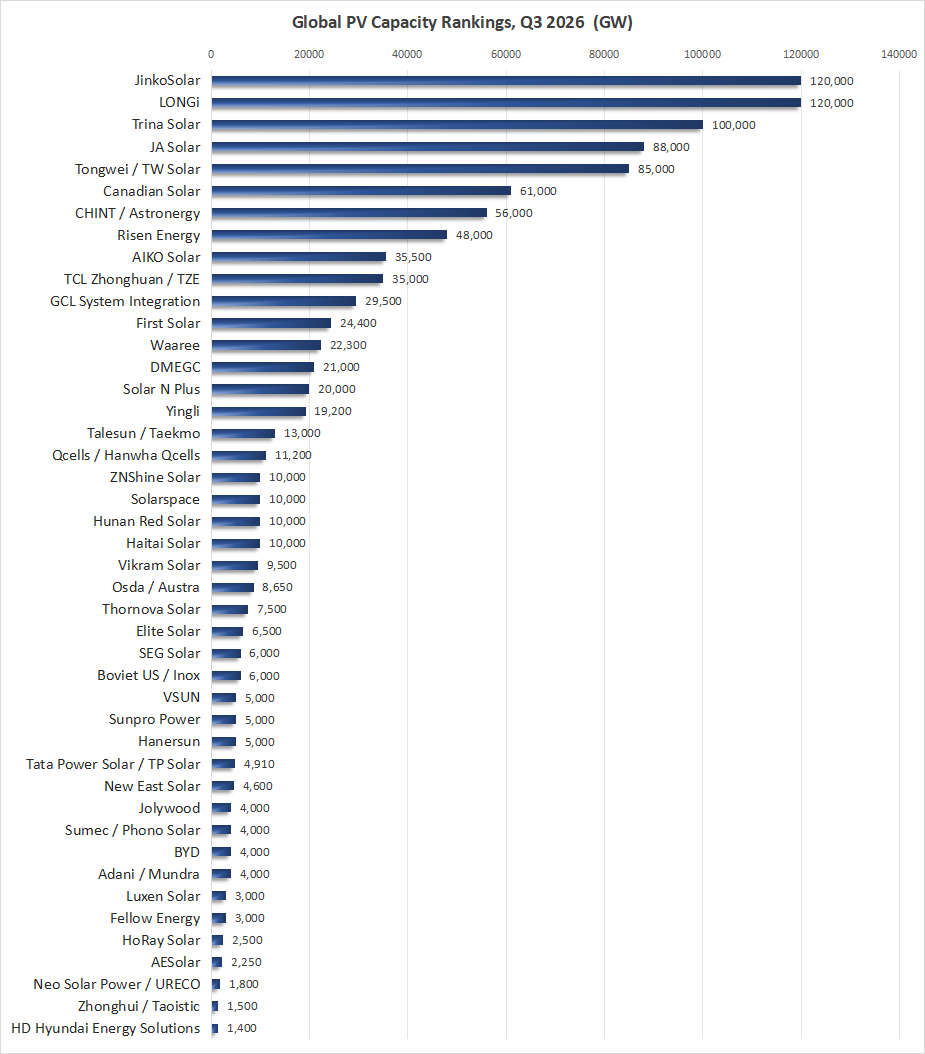
Jinko Solar and LONGi are tied for first place, each with 120,000MW of annual production capacity. Both firms are long-standing pioneers in the global PV sector and have continuously expanded their manufacturing footprints across wafer, cell and module production, according to corporate disclosures. Trina Solar follows in third place with a capacity of 100,000MW, maintaining its position as one of the world’s largest fully integrated solar manufacturers. JA Solar, Tongwei and Canadian Solar complete the top six with capacities of 88,000MW, 85,000MW and 61,000MW respectively. This leading group accounts for a substantial share of total global module output, built on years of capital investment, supply chain vertical integration, and a track record of delivering international projects.
The next tier of manufacturers comprises well-established companies with an annual capacity of between 24,000 and 56,000MW. Prominent companies in this bracket include Chint Astronergy, Risen Energy, Aiko Solar and TCL Zhonghuan. First Solar, the leading US-headquartered thin-film PV producer, is in 12th place with an annual capacity of 24,400MW. Unlike most of its crystalline silicon competitors on the list, First Solar’s core production platform is cadmium telluride thin-film technology, as detailed on its corporate website. This gives it a distinct product profile within the Tier 1 cohort. India’s Waaree is another notable regional heavyweight, ranking 13th with an annual capacity of 22,300MW. This reflects India’s national push to expand domestic solar manufacturing capacity and reduce import dependency.
The mid and lower sections of the ranking demonstrate the growing geographic spread of bankable PV suppliers beyond traditional East Asian manufacturing hubs. Several Indian companies appear on the list, including Vikram Solar, Tata Power Solar and Adani Mundra. These businesses are central to India’s domestic renewable energy development, supported by national production incentive schemes. European and Western manufacturers are also represented, including Boviet US/Inox, as well as smaller specialist producers from South Korea and other regions. Several firms are clustered around the 10,000MW mark, including ZNShineSolar, Solarspace, Hunan Red Solar and Haitai Solar. This shows that there is a broad middle band of manufacturers that are capable of serving both the utility-scale and the distributed solar markets.
Market share and project delivery volumes are not directly equated with capacity alone. BloombergNEF’s Tier 1 framework is based on bankability criteria, which measure a manufacturer’s financial resilience, long-term operational viability, and ability to honour product warranties over the course of several decades. This metric is particularly important for investors in utility-scale solar projects, who require assurance that their suppliers will remain operational for the full lifetime of their photovoltaic assets. Manufacturers with large production capacity may not always prioritise the same product segments: some focus on high-efficiency utility modules, while others target the residential and commercial rooftop markets.
Looking ahead, large-capacity Tier 1 producers are well placed to respond to the rising global demand for solar power as nations advance their net zero targets. Continued expansion of manufacturing capacity across Asia, alongside growing volumes from Indian and Western suppliers, suggests a more geographically diverse supply chain in the medium term. Nevertheless, the top five manufacturers retain a dominant collective position, highlighting that major crystalline silicon module production remains heavily concentrated among a small group of well-capitalised integrated solar enterprises.