
PVTIME – Construction work has officially begun on the first hydrogen pipeline in Saarland, which will form part of the cross-border mosaHYc hydrogen conversion project in Germany.
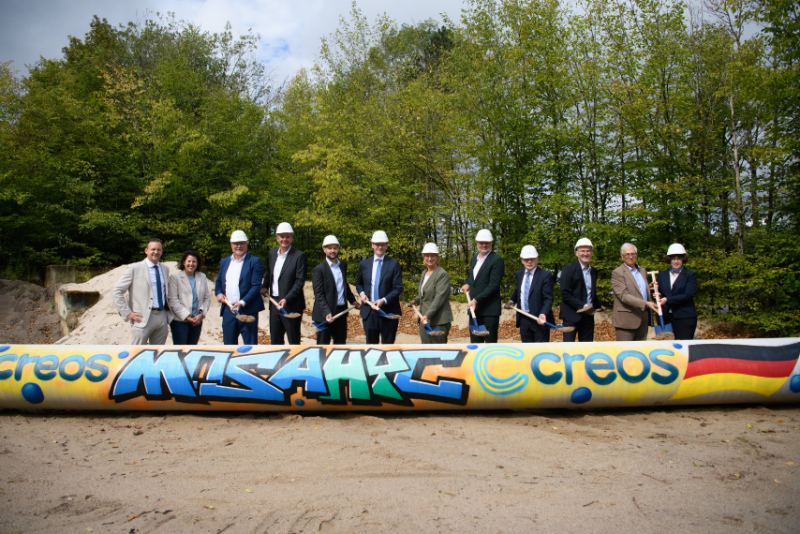
Saarland/Weyland
On 28 August 2026, Creos Deutschland held a formal groundbreaking ceremony in Wallerfangen to mark the start of civil engineering and pipe laying works. The 17-kilometre pipeline route between Leidingen and Dillingen secured final legal planning approval in July 2026, and is expected to take 18 months to complete. The project is being delivered by a specialised consortium of Enrotec and Max Streicher.
Recognised as an Important Project of Common European Interest, the German pipeline segment receives joint financial support from the federal government, the state of Saarland and other national authorities. Developed in partnership with the French network operator NaTran France, the cross-border scheme includes retrofitting 20 kilometres of existing pipeline and building 5 kilometres of new pipeline infrastructure in France, spanning the route between Leidingen and Bouzonville. The integrated network is designed to transport hydrogen sourced in France to industrial facilities in Dillingen.
The mosaHYc project has been designed to integrate fully into Europe’s expanding hydrogen infrastructure framework. It will connect to Germany’s core national hydrogen network, as well as to complementary European projects, including HY4LINK and HYFEN. This interconnected system will facilitate the import of hydrogen across borders from northern Germany, the Iberian Peninsula, Luxembourg and Belgium. It will deliver low-carbon energy supplies to large-scale industrial operators and focus on the decarbonisation of Saarland’s steel industry.
Industry leaders have emphasised the project’s strategic and collaborative value. Cross-national cooperation is essential for delivering this critical energy infrastructure, demonstrating unified industrial and climate action across European borders. Following the sector’s historic shift from coke oven gas to natural gas in the 1970s, the pipeline marks a transformative upgrade for regional energy networks. This modern transition establishes a resilient, future-ready, climate-secure energy framework for regional operations.
Senior executives from the Encevo group confirmed the essential role of hydrogen in hard-to-electrify industrial processes and heavy-duty transport. They stated that mosaHYc represents a foundational step for the development of scaled hydrogen infrastructure across the European Greater Region. Based in Homburg Saar, Creos Deutschland manages 1,600 kilometres of high-pressure gas networks and 400 kilometres of high- and medium-voltage power infrastructure across Saarland and Rhineland-Palatinate. The company also holds official operator status within Germany’s national core hydrogen network programme.