

PVTIME – A team of researchers from the Technical University of Munich (TUM) has developed a solution to mitigate the performance degradation of perovskite solar cells caused by weather conditions. In collaboration with colleagues from the Karlsruhe Institute of Technology (KIT), the German Electron Synchrotron (DESY), and the Royal Institute of Technology in Stockholm (KTH), the group identified the microscopic mechanisms driving material degradation during temperature fluctuations.
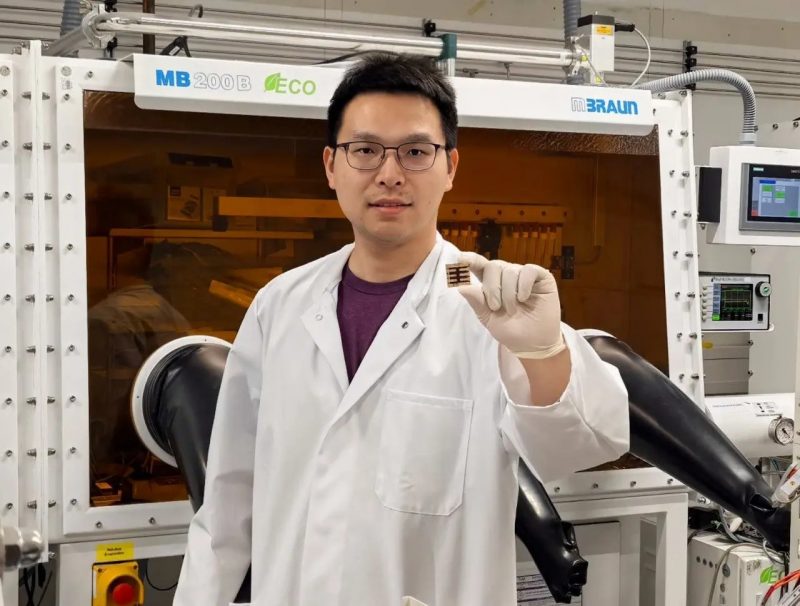
Dr Kun Sun is holding a perovskite solar cell
Their findings, published in Nature Communications, reveal that perovskite cells may experience a relative performance drop of up to 60% during the initial ageing phase. The study emphasises the critical role of thermal cycling in early-stage degradation, with the research team focusing on stabilising the material’s fragile crystal structure using specially designed molecular anchors.
Peter Müller-Buschbaum, Professor and Head of the Department of Functional Materials at TUM’s School of Natural Sciences, emphasised that perovskite cells must perform reliably outdoors as well as in laboratory settings if they are to be viable for rooftop deployment.
The team pinpointed the microscopic cause of structural instability and developed a new design strategy to reinforce the top layer of tandem solar cells to withstand real-world conditions. Lead author Dr Sun Kun outlined that performance loss arises from microscopic tension and energy-consuming structural changes.
A companion paper in ACS Energy Letters details the solution: special organic molecules act as spacers to secure the crystal structure, functioning as molecular scaffolding. Tests confirmed that the larger organic molecule 1,4-phenylenedimethanammonium (PDMA) serves as an effective anchor, producing robust cells that remain stable when subjected to mechanical stress resulting from rapid thermal cycling.
Professor Müller-Buschbaum noted that a better understanding of these microscopic processes paves the way for the next generation of solar modules, which combine high efficiency with the durability required for decades of outdoor use. The commercialisation of perovskite technology has long been hindered by stability issues, as evidenced by recent studies, including one from the University of Sydney published last October.

Scan the QR code to follow PVTIME official account on Wechat for latest news on PV+ES
 has developed a solution to mitigate the performance degradation of perovskite solar cells caused by weather conditions.…)