
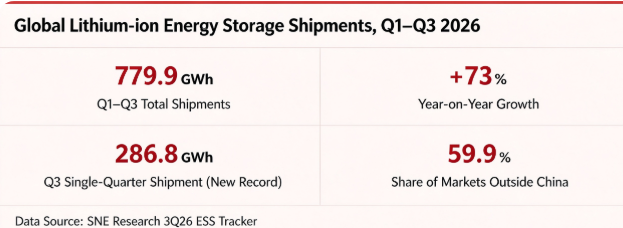
PVTIME – According to SNE Research’s 3Q26 ESS Tracker, global lithium-ion energy storage cell shipments reached 779.9GWh in the first three quarters of 2026, representing a 73% year-on-year rise. The third quarter alone saw 286.8GWh delivered, setting a new single-quarter record. Notably, markets outside China accounted for 59.9% of global shipments, signalling a shift in the centre of gravity for storage demand away from the domestic Chinese market.
Nevertheless, China remains the world’s largest single national market, with shipments totalling 313.1GWh in Q1–Q3 2026, marking a 42% year-on-year increase. However, its market share fell from 48.9% in the same period of 2025 to 40.1%. The fastest-expanding category is other regions, where shipments reached 213.4GWh, marking a 140% year-on-year increase and raising its global share from 19.7% to 27.4%. North America and Europe posted growth of 71% and 87%, respectively. Within these emerging markets, the Middle East delivered 58.7GWh (+157%), non-China Asia delivered 48.7GWh (+153%), and Australia delivered 54.0GWh (+113%). As trade policies and localisation rules tighten across North America and Europe, the importance of local manufacturing capacity and regulatory compliance when buyers select storage suppliers will grow.
Application Segments
Utility-scale storage remains the dominant segment, with shipments totalling 575.9GWh, which equivalent to 73.8% of the global total. Residential storage was the fastest-growing of the three core application categories, with shipments climbing from 38.6GWh to 97.5GWh, represeting a year-on-year increase of 152%, lifting its share from 8.6% to 12.5%. However, Q3 residential shipments totalled 33.8GWh, marking a 9% quarter-on-quarter decline, primarily driven by a 19% drop in volumes destined for Europe. Commercial and industrial (C&I) storage grew by 57% to 62.2GWh. Energy storage for AI data centres, a fast-emerging niche, reached 14.4GWh, marking a 141% year-on-year increase.
Manufacturer Landscape
The ranking of cell suppliers reveals a dynamic competitive landscape, with divergent growth rates reshaping positions. CATL retained first place with shipments of 198.3GWh, edging its global market share up slightly from 25.1% to 25.4%. Its Q3 shipments of 73.3GWh rose 64% year-on-year. Hithium moved up from third place at the mid-year mark to second with 75.7GWh, while EVE Energy ranked third with 71.6GWh.
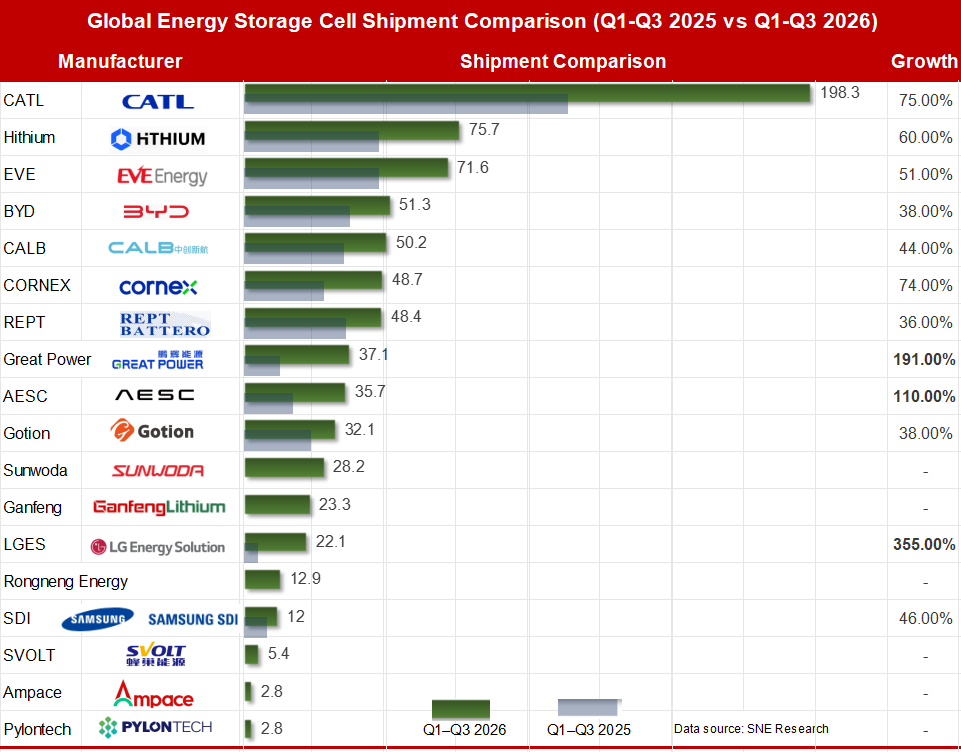
The mid-tier competition is exceptionally tight. The gap between fourth-placed BYD (51.3GWh) and seventh-placed REPT (48.4GWh) is just 2.9GWh. CALB took fifth position with 50.2GWh, and Cornex climbed to sixth with 48.7GWh. Great Power and AESC achieved impressive growth of 191% and 110% respectively, which is well above the market average of 73%. BYD’s Q3 shipments of 15.6GWh declined by 5% year-on-year, limiting its growth from Q1 to Q3 to 38%.
The combined market share of the top three suppliers, including CATL, Hithium, and EVE Energy, fell from 46.1% to 44.3%. Among the top ten manufacturers, only three recorded year-on-year share gains: Great Power (+1.9 percentage points), AESC (+0.8 percentage points), and CATL (+0.3 percentage points). Cornex held its share steady, while the remaining six top-ten players lost share. AESC’s shipments increased from 17.0GWh to 35.7GWh, propelling it to ninth place. Its strength lies in utility-scale storage, where it holds a 6% share, represeting 1.3 percentage points higher than last year.
From this reporting cycle, SNE Research tracks six suppliers individually: Sunwoda (11th, 28.2GWh), Ganfeng Lithium (12th, 23.3GWh), Rongneng Energy (14th, 12.9GWh), SVOLT (16th, 5.4GWh), and Ampace and Pylontech (joint 17th, 2.8GWh each). Together, they shipped 75.4GWh, accounting for 9.7% of the global market. Residential storage makes up 26% of their combined output, which is higher than the global average residential share of 12.5%. Korean suppliers also experienced significant growth: LGES ranked 13th with 22.1GWh (+355%), and Samsung SDI ranked 15th with 12.0GWh (+46%).
Competitive Structure by Application
Concentration varies markedly across end markets. In utility-scale storage, the top five suppliers hold around 65% of the market. CATL is in the lead with 28%, followed by Hithium (13%), EVE Energy (8%), CALB (8%), and BYD (7%). Cornex and AESC each hold 7% and 6% respectively. Meanwhile, the utility segment’s share of total storage volumes has slipped from 76.1% to 73.8%.
The C&I storage segment is more fragmented. Together, CATL and REPT capture more than half of the market, with CATL holding 35% and REPT holding 15%. No other supplier holds more than 10% of the C&I market. BYD increased its C&I shipments from 0.9GWh to 5.7GWh, raising its market share by 6.8 percentage points.
Residential storage is the most concentrated of the three core segments. REPT has held the number one residential position for seven consecutive quarters since Q1 2025, shipping 22.9GWh and achieving a 24% market share in Q1–Q3 2026. Great Power ranks second with 20%, and EVE Energy third with 19%. The top three control 62% of the residential market. European demand remains the largest residential market, with shipments reaching 33.1GWh (+140%), followed by Australia with 23.1GWh (+86%). Great Power’s residential shipments surged by 293% year on year, increasing its market share from 12.5% to 19.5%.
SNE Research forecasts continued demand diversification, with the Middle East and other Asian emerging markets set to experience rapid expansion. The competitive hierarchy in the closely packed mid-tier may shift again in Q4, driven by the timing of large-scale project deployments. Residential and AI data centre storage will remain key growth drivers. Pricing aside, supply-chain reliability, localised manufacturing and regulatory compliance are becoming central decision criteria for global energy storage buyers.