
PVTIME – An independent energy analysis by Carbon Brief, based on data from the Energy Institute’s Statistical Review of World Energy, confirms that wind and solar power generation in Germany exceeded that of fossil fuels for the first time in 2025. The country’s combined photovoltaic and wind energy production totalled 225TWh, accounting for 44% of national power generation, while fossil fuel sources contributed 217TWh, making up 43% of the total. This landmark shift was also observed across the broader European Union, which recorded the same renewable energy generation milestone in 2025.
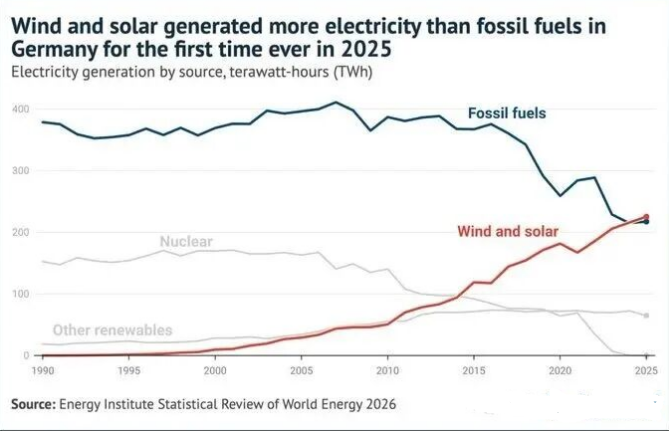
This industry breakthrough stems from two decades of steady growth in Germany’s onshore wind and solar sectors, driven by the national Energiewende energy transition strategy. To accelerate the development of low-carbon technologies, Germany approved a record 20.8GW of new renewable energy capacity in 2025 alone. The nation has set clear medium- and long-term climate targets, including installing 115GW of onshore wind capacity and achieving 80% renewable electricity penetration by 2030, achieving a largely climate-neutral power system by 2035, and reaching full economy-wide net zero emissions by 2045.
However, Germany’s nuclear phase-out policy poses greater challenges for the deployment of renewable energy compared to neighbouring European economies such as France and the UK. Although the current German Chancellor, Friedrich Merz, has publicly questioned the strategic rationale of the nuclear exit, the incumbent government has confirmed that there will be no reversal of the plans to phase out nuclear power.
The most pressing challenge for Germany’s energy transition is coal dependency, with the country relying far more heavily on coal power than its European counterparts. Although a statutory coal phase-out deadline has been set for 2038, sector experts anticipate an earlier exit, despite recent energy market pressures having slowed transition progress.
The federal government is advancing plans for new gas-fired power facilities, which are classified as transitional energy assets. These plants are scheduled to be converted for operation using green hydrogen by 2045, in order to comply with national climate neutrality objectives. There is growing political resistance to renewable expansion, primarily from the Alternative for Germany party, with few other political groups proposing changes to the established coal phase-out roadmap. A key benchmark for the government’s ongoing commitment to national energy transition targets will be an official timeline review report due for publication in August.

Scan the QR code to follow PVTIME official account on Wechat for latest news on PV+ES