
PVTIME – Published industry shipment data for the first six months of 2026 shows a general contraction in year-on-year figures among the world’s leading photovoltaic module suppliers. Chinese vertically integrated manufacturers continue to dominate the global top 10. Only two participants achieved positive shipment growth amid widespread volume reductions caused by oversupply in the industrial chain and cross-border trade constraints.
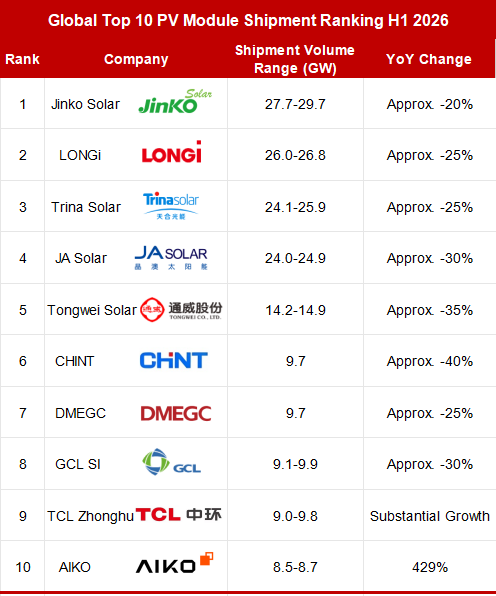
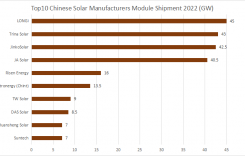
Jinko Solar maintained the number one global ranking for six consecutive calendar months, with shipments ranging from 27.7GW to 29.7GW, a reduction of around 20% year on year. LONGi secured second position with shipments ranging from 26.0GW to 26.8GW, marking a 25% year-on-year decline. Meanwhile, Trina Solar took third place with shipments ranging from 24.1GW to 25.9GW, reflecting an equivalent 25% year-on-year decrease. JA Solar ranked fourth with shipments ranging from 24.0GW to 24.9GW and a 30% year-on-year contraction. Tongwei Solar claimed fifth place with shipments ranging from 14.2GW to 14.9GW and a 35% year-on-year fall.
Mid-table players experienced increased downward pressure on volumes. CHINT recorded a flat shipment output of 9.7GW, marking a 40% year-on-year decline. Meanwhile, DMEGC matched this exact shipment figure, though with a milder annual reduction of 25%. GCL System Integration delivered shipments ranging from 9.1GW to 9.9GW, equating to a 30% year-on-year decrease.
However, two market participants bucked the prevailing downward trajectory entirely during this period. TCL Zhonghuan achieved substantial overall growth thanks to its module products matched to large-size silicon wafers. Its second-quarter shipments doubled quarter-on-quarter, and its energy storage-compatible modules recorded rapid volume uptake. AIKO Energy was the only leading manufacturer to achieve high growth, with shipments surging by 429% year-on-year, driven by the successful commercial rollout of its proprietary ABC back-contact cell technology.
Strategic operational decisions underpinned the divergent shipment outcomes recorded across the ranking. Jinko Solar mitigated international trade barriers through a globalised production framework, with overseas shipments accounting for over 80% of its total output, thereby maintaining its position as a leading global manufacturer. LONGi stabilised its core order base within domestic distributed photovoltaic assets and utility-scale ground-mounted power stations by deploying differentiated BC back-contact technology. Trina Solar integrated photovoltaic and energy storage development into its core business model, with N-type modules accounting for over 95% of its total production capacity, thereby securing sufficient energy storage capacity to meet demand in the European and American markets.
JA Solar adopted a balanced domestic and international operational framework. Relying on parallel delivery streams of overseas engineering, procurement and construction contracting, as well as domestic distributed photovoltaic project supply, the company was able to guarantee consistent product dispatch volumes. Tongwei Solar achieved cost advantages through full vertical polysilicon chain integration, enabling it to lead the domestic distributed photovoltaic market segment in China. CHINT focused its resources on distributed photovoltaic applications, accelerating its commercial expansion across emerging markets in the Middle East and Southeast Asia. Meanwhile, DMEGC generated notable incremental volumes through expanded sales channels across Europe.
GCL System Integration continued to release capacity for N-type TOPCon products, operating a dual commercial model that combined proprietary brand sales with overseas original equipment manufacturer production in order to utilise available manufacturing capacity. TCL Zhonghuan’s growth trajectory was anchored by large-format silicon wafer matching modules and the rapid scaling up of energy storage accessory products in the second quarter. AIKO Energy’s disruptive ABC/BC module technology delivered transformative shipment growth, marking the most significant year-on-year increase in volume among all the top 10 listed enterprises.
The results of the six-month shipment period confirm that long-term competitiveness within the global photovoltaic sector is no longer dependent on pure output scale. Instead, a sustainable market position is achieved through hedging against barriers by deploying production internationally, upgrading high-efficiency N-type cell technologies iteratively, optimising costs within the industrial chain, penetrating segmented downstream markets selectively, and bundling photovoltaic products synergistically with energy storage solutions. These core operational pillars will continue to influence manufacturer rankings and commercial performance until the end of 2026.
Five-Year Evolution of Global PV Module Supplier Rankings (2021–2025)
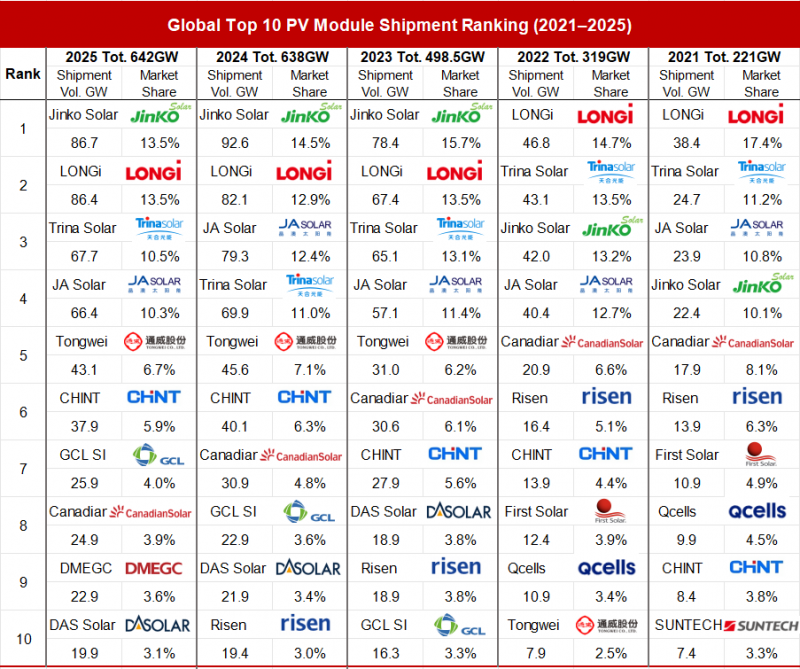
Based on a definitive dataset jointly published by CPIA and PV InfoLink, the five-year record of global photovoltaic module shipments shows significant overall market growth alongside a clear change in the industry’s competitive landscape. Total annual global module shipments increased consistently from 221GW in 2021 to 642GW in 2025, driven by international renewable energy commitments and national decarbonisation strategies that support the deployment of large-scale solar assets worldwide.
Throughout the review period, vertically integrated Chinese photovoltaic manufacturers secured dominant market control, with only a few overseas operators intermittently maintaining top ten positions. LONGi claimed the number one global ranking in both 2021 and 2022, after which Jinko Solar took the leading position from 2023 to 2025. Jinko Solar achieved annual shipments of 86.7GW and a 13.5% market share in 2025, following volumes of 92.6GW with a 14.5% share in 2024, and 78.4GW with a 15.7% share in 2023. LONGi held second position each year of the five-year period, with 86.4GW of shipments and a 13.5% market share in 2025, thus maintaining its stable large-scale market presence.
There has been rotational movement among the three core domestic manufacturers in the second tier of leading suppliers. Trina Solar finished 2025 in third place, having shipped 67.7GW and achieved a 10.5% market share. This was an improvement on its ranking in 2023, when it was third, and in 2022, when it was second. JA Solar finished fourth in 2025 with 66.4GW of shipments and a 10.3% market share, maintaining a top-four position throughout the five-year period. Tongwei Solar held the fifth position every year from 2021 to 2025, increasing annual shipment volumes from 17.9GW in 2021 to 43.1GW in 2025 through cost efficiencies derived from a fully integrated polysilicon-to-module supply chain.
Participants in the middle of the table experienced greater volatility in annual rankings, a trend directly linked to upgrades in product technology and targeted strategies for penetrating end markets. CHINT secured sixth place in both 2024 and 2025, maintaining annual shipments between 37.9GW and 40.1GW. This was supported by the company’s focus on developing distributed photovoltaic applications and rolling out the market across emerging economies in the Middle East and Southeast Asia. GCL System Integration achieved seventh position in 2025 through sustained capacity expansion for N-type TOPCon products and a dual operating framework combining proprietary brand sales and cross-border OEM arrangements. DMEGC and DAS Solar maintained consistent top-ten placements in the latter part of the period, primarily due to expanded European distribution channels and optimised product portfolios.
Over the five-year cycle, international legacy photovoltaic firms gradually eroded their global market presence. First Solar was in the top ten only in 2021 and 2022, Qcells appeared occasionally between 2021 and 2023, and Suntech Power left the rankings after finishing tenth in 2021. This gradual retreat reflects slower progress in the commercialisation of high-efficiency N-type cell technology and less agile adaptation to complex cross-border trade compliance rules, compared with integrated Chinese peers that established localised production facilities overseas to mitigate tariff barriers.
Market concentration among the top four suppliers remained high year on year amid overall market expansion. All incremental shipment growth within the expanding global market pool, which grew from 221GW to 642GW, has been absorbed by leading vertically integrated domestic enterprises. The five-year quantitative dataset confirms that vertical chain cost control, the accelerated rollout of advanced N-type cell technologies, the deployment of a global production footprint for mitigating trade risks, and the development of segmented markets for utility-scale and distributed photovoltaic assets are the core competitive drivers that will continue to shape the performance of suppliers in future trading cycles.

Scan the QR code to follow PVTIME official account on Wechat for latest news on PV+ES