

PVTIME – The industry analysis is based on the Supplementary List of Key Chinese Energy Storage Enterprises (2026), which is a consolidated dataset profiling 26 leading domestic energy storage system (ESS) companies. The dataset includes both publicly traded industrial conglomerates and unlisted technology ventures specialising in ESS cell manufacturing, power conversion system (PCS) hardware, grid-side system integration, residential storage hardware, and long-duration energy storage research. The published table captures each entity’s disclosed market capitalisation or independently estimated valuation, core operational focus, secured framework order backlog and distinct competitive strengths.
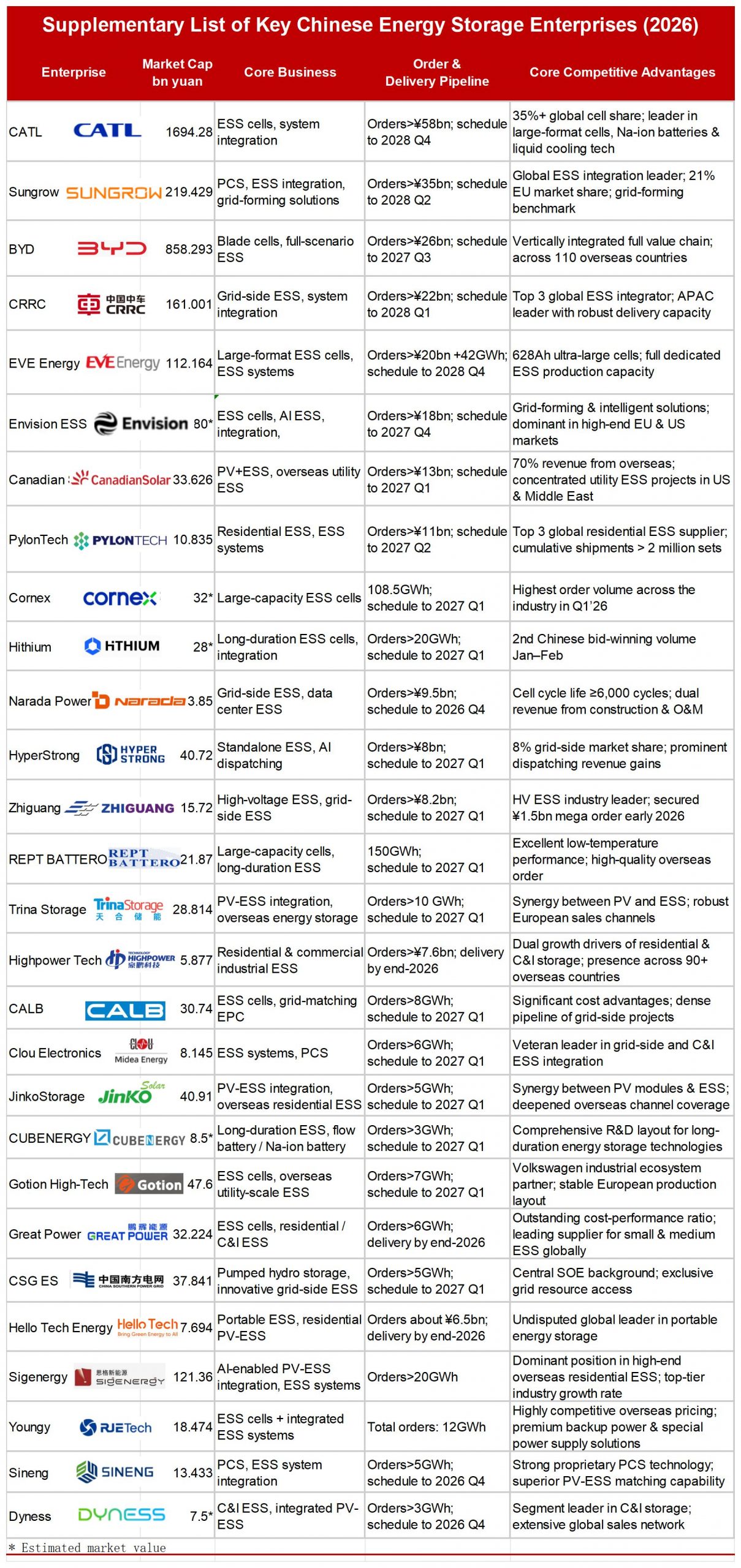
It should be noted that this evaluation is based on an incomplete set of data, as it relies exclusively on published industry framework order volumes and market valuation metrics from mid-2026. Unpublished preliminary memoranda of understanding and small-volume ad hoc international spot supply contracts are outside the scope of the dataset, which limits full market visibility. Nevertheless, the material provides robust insight into the structural dynamics that define China’s ESS sector in 2026.
A clear three-tier competitive hierarchy emerges among the cohort, defined by total market capitalisation and aggregate secured order volumes. The top tier comprises fully integrated industrial groups with a market capitalisation of over 100 billion yuan. This tier is headed by CATL with a market capitalisation of 1,694.28 billion yuan, followed by BYD with 858.293 billion yuan. CATL holds a 35% global market share of energy storage cells and is the industry leader in large-format cell design, sodium-ion cell engineering, and liquid cooling thermal management solutions. The company has binding framework orders valued in excess of 58 billion yuan, with delivery schedules stretching to the end of 2028, ensuring consistent full-capacity manufacturing output. BYD’s competitive positioning stems from its end-to-end vertical integration of proprietary blade cell technology and a full-spectrum ESS product portfolio. The company has established commercial activity across 110 international territories, forming substantial barriers against mid-market competitors. Sungrow Power, valued at 219.429 billion yuan, and CRRC, valued at 161.001 billion yuan, complete the upper tier as specialist system integrators. Sungrow controls 21% of the European ESS integration market with its reliable grid-forming hardware. CRRC ranks among the world’s top three grid-side integration providers and has unmatched delivery capacity in the Asia-Pacific region.
The second tier comprises dedicated ESS specialists with valuations ranging from 10 to 120 billion yuan. These specialists are split across two distinct market verticals. Prominent global residential storage specialists within this grouping include PylonTech and Sigenergy. PylonTech is one of the world’s top three residential ESS suppliers. It has shipped over two million units and has secured orders worth more than ¥11 billion, scheduled for delivery by Q2 2027. Sigenergy delivers artificial intelligence-enabled photovoltaic energy storage integration systems and holds framework orders exceeding 20GW, while expanding year on year within the premium residential ESS markets in Europe and North America. Cell manufacturing specialists such as EVE Energy, CALB and REPT BATTERO focus their production lines on high-capacity ESS cells. EVE Energy has full production capacity dedicated to its 628Ah ultra-large format cells and has secured 42GW of multi-year framework orders for delivery up to Q4 2028 to meet demand for utility-scale assets overseas. Grid-side and C&I ESS suppliers, including Zhiguang Electric, Clou Electronics and Sineng Electric, capture stable demand within domestic energy infrastructure projects by leveraging proprietary high-voltage ESS and PCS hardware to secure long-term public grid supply agreements.
The third tier consists of unlisted technology innovators, which are marked with an asterisk in the published table to indicate their estimated market value rather than their exchange-traded capitalisation. Cornex, Hithium, Cubenergy and Dyness focus their product development on specialised long-duration and niche ESS hardware. Hithium’s long-duration cell range secured the second-highest volume of successful national tender bids in January and February 2026. Meanwhile, Cubenergy allocates dedicated research and development resources to flow battery and sodium-ion storage technology, positioning the firm to capture emerging demand for extended-cycle ESS. Although these unlisted ventures lack the substantial capital reserves held by listed industrial conglomerates, they secure international client contracts through optimised low-temperature cell performance and fully customisable product engineering.
All participants demonstrate clear vertical specialisation in order to mitigate market saturation within crowded segments. CRRC, Narada Power and CSG ES dominate grid-connected, utility-scale ESS deployment. Backed by central, state-owned enterprise governance, CSG ES holds exclusive access to national grid procurement frameworks. Photovoltaic-energy storage integration is a universal international expansion strategy adopted by Canadian Solar, Trina Storage and JinkoStorage. These companies leverage pre-existing global photovoltaic distribution networks to reduce market entry overheads for their ESS product ranges. Portable mini-scale residential storage operates as an isolated, high-growth sector. Hello Tech Energy holds undisputed global market leadership for portable ESS hardware.
International revenue streams are a key driver of sustained annual growth for almost all listed and unlisted participants. Canadian Solar generates 70% of its total turnover from cross-border markets. Meanwhile, Sungrow, PylonTech and Sigenergy are directing significant operational resources towards utility-scale and residential ESS in Europe, the United States and the Middle East. The European market remains the main competitive arena for cross-border operations, where grid-forming hardware functionality, low-temperature cell performance and modular, standardised system design are the main benchmark metrics for client tenders.
Although an incomplete data set restricts this analysis from capturing small-scale regional integration firms and recently founded technology developers, two definitive industry trajectories can be identified from the consolidated data set. Vertically integrated top-tier conglomerates will continue to expand their global market share by placing multi-year binding framework orders, which will put downward pressure on the gross margins of independent component manufacturers operating on a smaller scale. Mid-tier suppliers and unlisted technology ventures will rely on product differentiation as their primary sustainable commercial strategy. They will target long-duration storage, portable ESS hardware, or regional and international niche demand pools, in order to avoid unprofitable, homogeneous price competition. The rising global penetration of renewable power generation will drive sustained investment in long-duration ESS and AI-powered energy dispatching platforms. All enterprise tiers will commit increased research and development funding to these technology streams over the next three financial years.

Scan the QR code to follow PVTIME official account on Wechat for latest news on PV+ES

, which is a consolidated dataset profiling 26 leading domestic energy storage system…)