

PVTIME – Queensland’s battery energy storage sector has undergone a significant regulatory overhaul, with the state government formally issuing the 2025 Planning (Battery Energy Storage Systems) and Other Legislation Amendment Regulation.
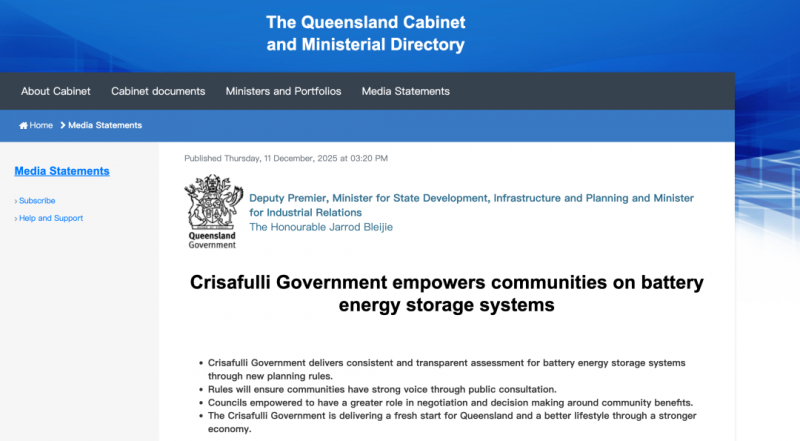
Effective from 12 December 2025, the regulation will transfer approval powers for large-scale battery storage projects in Queensland from local councils to the State Assessment and Referral Agency, marking the end of the industry’s unregulated expansion phase and introducing a new era of standardised, state-level oversight. Prior to this reform, Queensland’s 77 local councils operated under inconsistent frameworks, many of which lacked updated provisions for energy storage developments, resulting in lengthy approval timescales and significant uncertainty for project developers. The new regulation introduces a clear 50MW threshold, categorising projects of this capacity or above as ‘Impact Assessable’ developments. These projects are now subject to mandatory community consultation and transparent public scrutiny processes, designed to prevent unannounced commissioning.
Although the centralisation initiative is intended to streamline the approval process, it introduces two mandatory prerequisites for projects that meet the 50MW threshold. Before submitting applications to the State Assessment and Referral Agency, developers must complete a comprehensive Social Impact Assessment evaluating the full range of effects on local residents and sign a legally binding Community Benefits Agreement with the relevant local council. These requirements transform vague community contributions into clearly defined contractual commitments, ensuring that local areas gain tangible benefits from hosting energy storage facilities, rather than viewing them purely as industrial infrastructure. Queensland Deputy Premier Jarrod Bleijie stated that the reforms were underpinned by fairness and trust, adding that local communities had previously been sidelined in energy project decision-making and that the new measures would re-establish their influence in such critical initiatives.
Alongside procedural changes, the state government has released State Guideline 27: Battery Energy Storage Systems, which enforces uniform technical standards across all large-scale projects. The guideline sets out strict, mandatory requirements covering bushfire risk assessment, noise control, visual screening, and the protection of agricultural land, replacing the superficial, aesthetic-focused checks previously conducted by some local councils.
Notably, the regulation has retrospective effects. Developers with pending applications for projects of 50MW or more that have not received formal approval by 12 December 2025 must complete supplementary social impact assessments and have their projects reassessed by the State Assessment and Referral Agency.
The introduction of the Social Impact Assessment and Community Benefits Agreement framework brings Queensland’s regulatory approach into line with that of more established European and North American markets. Although the reform increases developers’ workload during the initial application phase, it replaces ambiguous compliance risks with clearly defined costs. In future, competition in Queensland’s battery storage sector will depend not only on cost efficiency and technological capability, but also on developers’ ability to foster strong community collaboration and meet rigorous compliance standards. This will determine which players can secure a sustainable position in the state’s clean energy transition.

Scan the QR code to follow PVTIME official account on Wechat for latest news on PV+ES





 and Other Legislation Amendment…)