
PVTIME – We collected the data and created this bar chart, which outlines the top 20 global listed energy storage enterprises, ranked by market capitalisation (measured in billions of US dollars) as of 15:00 CST on 15 July 2026. The league table vividly illustrates China’s industrial dominance across the entire energy storage value chain, alongside leading international specialists, in the context of global decarbonisation and the rollout of renewable energy.
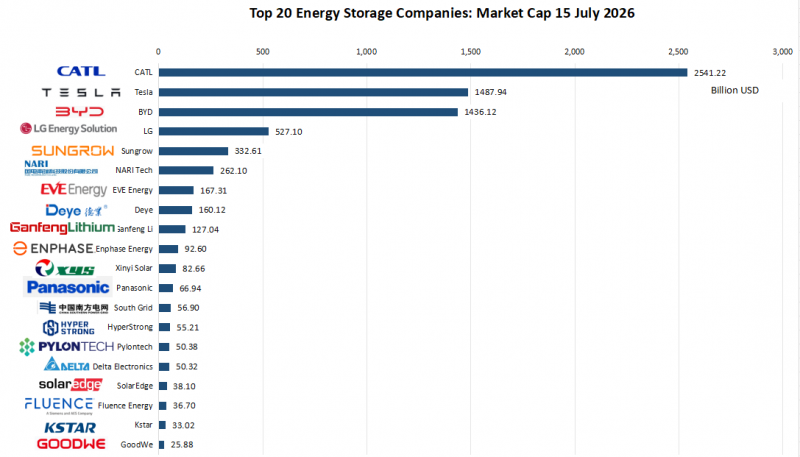
CATL secures first place with a market valuation of 2,541.22 billion USD. As the world’s largest producer of lithium-ion cells, it supplies battery products for utility, commercial, and residential storage deployments worldwide, which underpins its dominant market position. Tesla follows in second place with a valuation of 1,487.94 billion USD. Its vertically integrated energy storage portfolio, including Megapack and Powerwall, establishes the firm as a leading US player in the delivery of packaged storage hardware and energy management software. BYD ranks third with a valuation of 1,436.12 billion USD. Its blade battery technology is supporting the company’s rapid expansion into the stationary storage and electric mobility sectors.
LG Energy Solution is the highest-ranked non-Chinese battery maker, in fourth position with a valuation of 527.10 billion USD. The company has experienced substantial storage demand across North American and European markets. Chinese manufacturers occupy many subsequent spots: Sungrow (332.61 billion USD) is the global leader in storage inverters and system integration, and NARI Technology (262.10 billion USD) specialises in grid-side energy storage and smart power infrastructure. EVE Energy (valued at 167.31 billion USD) and Deye (valued at 160.12 billion USD) demonstrate China’s strength in energy storage cells and residential storage inverters, respectively.
Further down the ranking, Ganfeng Lithium focuses on upstream battery materials. Meanwhile, Enphase Energy dominates the distributed micro-inverter and home storage markets in the United States, while Xinyi Solar supports integrated solar-storage projects. Panasonic (USD 66.94 billion) maintains a steady supply of lithium cells for international storage schemes. Following this are a number of specialised storage firms, including South Grid Energy Storage, the large-scale integrator HyperStrong, the residential storage supplier Pylontech, the power equipment manufacturer Delta Electronics, the inverter specialist SolarEdge, the grid storage operator Fluence Energy, and the two prominent Chinese suppliers of commercial and household storage systems, Kstar and GoodWe.
Overall, the ranking highlights a clear industry trend: Chinese companies dominate cells, inverters, system integration and grid storage hardware. Meanwhile, North American and Asian companies maintain competitive positions in premium residential products, overseas project development, and advanced energy storage software. As nations accelerate the adoption of renewable energy, the capacity for scalable energy storage will remain central to the energy transition and the long-term stability of power systems.
This is very different from the April snapshot, which captured a striking shift in energy storage company valuations between April and July 2026.
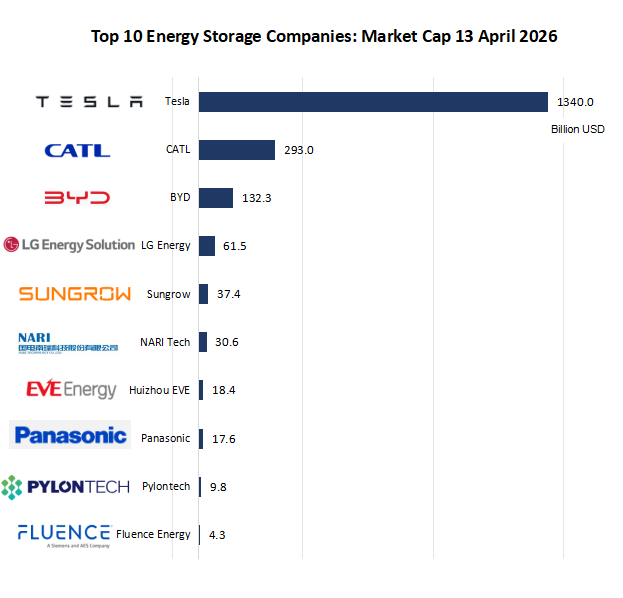
In April, Tesla topped the rankings, with CATL a distant second. Three months later, however, CATL overtook Tesla to claim first place, while BYD’s market capitalisation also expanded dramatically. This reshuffle was fuelled by stronger investor optimism regarding the order pipelines and improving profit outlooks of Chinese battery firms’ stationary storage. Meanwhile, the July list expands to include 20 companies, incorporating residential inverter manufacturers, grid storage equipment suppliers, and upstream material businesses that were not included in the April top 10. While LG Energy Solution retained fourth place, Western and Japanese companies, including Panasonic and Fluence, lost ground as investment shifted sharply towards China’s integrated energy storage supply chain.
Scan the QR code to follow PVTIME official account on Wechat for latest news on PV+ES