

PVTIME – Researchers at the Fraunhofer Institute for Solar Energy Systems (ISE) in Germany have announced two new efficiency records for tandem PV modules. Both modules are based on III-V semiconductor materials, which are derived from elements in Groups III and V of the periodic table and are renowned for their high conversion efficiency. One germanium-based III-V module achieved an efficiency of 34.2%, becoming the world’s most efficient PV module, while a silicon PV module based on III-V materials reached 31.3% efficiency, setting a new benchmark for its category.
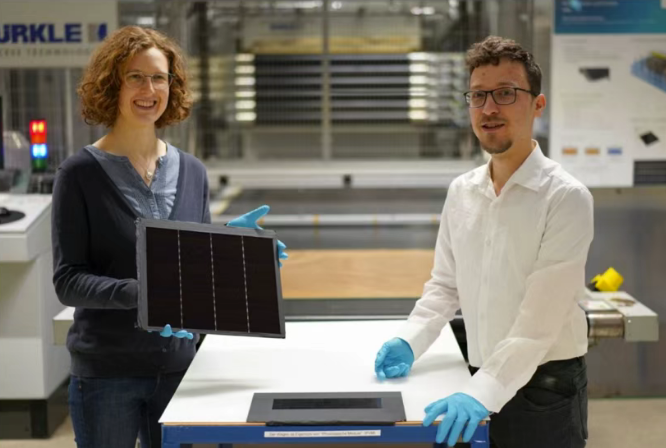
Laura Stevens (left), Project Manager at Fraunhofer ISE, holds the III-V germanium module that set a 34.2% efficiency record. Image: Fraunhofer ISE.
The 34.2% efficient module covers an area of 833cm² and is part of Fraunhofer’s Vorfahrt project, which focuses on developing cost-effective III-V batteries. Such batteries are typically used in vehicles, aircraft, and space applications, but have historically been associated with high costs as a challenge that the Vorfahrt project aims to address. The module was constructed by the project’s coordinator, Azur Space Solar Power, using triple-junction III-V germanium cells optimised for the terrestrial solar spectrum. Its efficiency was further enhanced by project partner Temicon through the application of a nanoimprint process to the module’s glass surface, reducing reflection losses.
The 31.3% efficient III-V silicon PV module builds on a previous record set several years ago, when a III-V silicon solar cell achieved an efficiency of 36.1%. This module is part of Fraunhofer’s Mod30plus research project, which aims to develop III-V/silicon modules with an efficiency of at least 30%. As part of this initiative, scientists produced the solar cells on a small scale, adapted them for interconnection using shingling technology, and ultimately assembled the 218cm² module that achieved the new efficiency record.
Andreas Bett, Director of Fraunhofer ISE, noted that tandem PV technologies could bridge the gap between traditional, cost-effective ground-mounted and rooftop systems, and high-performance, albeit more expensive, space solar cells. He explained that combining III-V materials with silicon offers a more economical option, whereas combining them with germanium provides a slightly more efficient alternative. He added that both options are highly attractive for integrated PV applications where space is limited.
Conventional silicon solar cells have a theoretical maximum efficiency of 29.4%, while commercially available modules typically reach around 24%.

Scan the QR code to follow PVTIME official account on Wechat for latest news on PV+ES

 in Germany have announced two new efficiency records for tandem PV modules. Both modules are based on III-V…)