
PVTIME – The US Department of Energy has officially renamed the National Renewable Energy Laboratory the National Laboratory of the Rockies. This move is widely seen as a significant indication of the Trump administration’s shift towards a more diversified energy strategy.
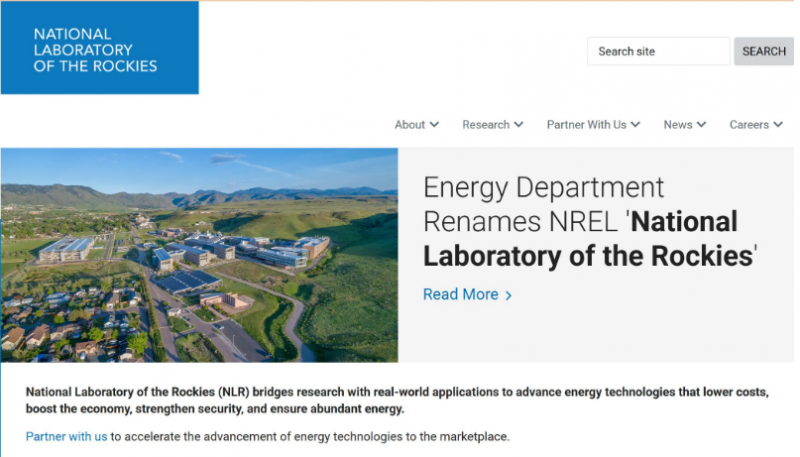
Headquartered in Golden, Colorado, the laboratory is overseen by the department and operates three national research platforms for bioenergy, solar energy, and wind energy. Established during the 1973 oil crisis, the laboratory has long been at the forefront of R&D in America’s renewable energy sector.
DOE Assistant Secretary Audrey Robertson explained that the current energy crisis differs greatly from the time when the laboratory was established, and that the US is no longer restricted to specific energy types. She emphasised that the newly named institution will focus on broader applied energy research, supporting goals including revitalising US manufacturing, cutting energy costs, and safeguarding supply security.
Laboratory director Judd Weldon noted that the new name reflects the DOE’s expanded mission and pays tribute to the region’s geographical features. The organisation will move beyond traditional renewable energy research to explore clean fossil fuel utilisation, nuclear energy, and energy storage technologies.
This rebranding aligns with the administration’s systemic adjustments to energy policy. Shortly after taking office in January, Trump announced that the US would withdraw from the Paris Agreement again, and halted over $300 billion in green infrastructure funding from the previous administration. In November, the Office of Clean Energy Demonstrations was dissolved and a new Office of Hydrocarbons and Geothermal Energy was established, prioritising oil and nuclear energy.
According to industry analysts, these measures constitute a policy loop. As the shale oil sector contracts amid falling prices and rising costs, the US is seeking to redirect research resources towards diversified energy areas in order to maintain its energy dominance. The administration has also launched an offshore oil and gas development plan, opening up drilling rights off the coast of California, Alaska, and other regions, a move which has drawn strong opposition from environmental groups and local governments.
However, energy experts caution that this shift in research could erode America’s technological gains in renewable energy. A previous laboratory report indicated that approximately half of US distribution transformers are approaching the end of their service life, and that their capacity will need to increase by between 60% and 160% by 2050 in order to adapt to upgrades in the energy infrastructure. Whether this transition can balance short-term energy security with the need for long-term transformation remains uncertain.

Scan the QR code to follow PVTIME official account on Wechat for latest news on PV+ES