

PVTIME – Spain’s Ministry for Ecological Transition and Demographic Challenge (MITECO) has recently announced the final selection results for energy storage projects under the European Regional Development Fund (ERDF) for the period 2021 to 2027. Following the receipt of 1,750 applications, the official budget was increased from an initial €700 million to €818.3 million, with 126 projects ultimately approved.
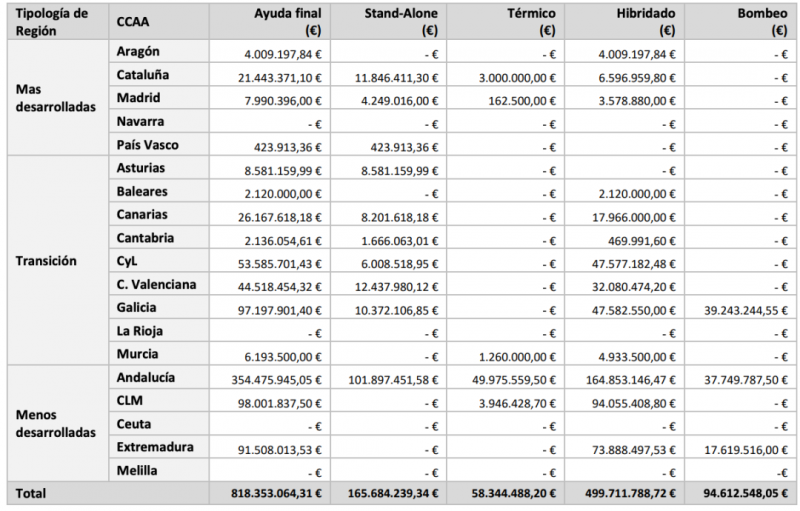
This marks Spain’s official shift in energy storage development from a phase of policy expectation to one of project delivery. A total of 2.2GW and 9.4GWh of energy storage will be deployed, and MITECO’s latest document specifies that the overall project implementation period ends no later than 31 December 2029, with each individual project required to be completed within 36 months of approval.
Notably, the plan permits up to 100% prepayment, which is an extremely rare practice in European public funding mechanisms. This measure clearly demonstrates the government’s intention to accelerate the deployment of energy storage and grid connection by improving cash flow.
In terms of technological structure, hybrid storage takes centre stage among the approved projects. There are 69 hybrid storage projects, 39 standalone storage projects, 15 thermal energy storage projects, and three pumped storage projects. Of the hybrid storage schemes, 38 combine solar with storage, 18 pair wind with storage, nine are combined heat and power hybrids, and four integrate solar, wind, and storage. This reflects the transition of energy storage from a supporting module in renewable energy projects to a core system element, with coupled energy storage and renewable power generation designs becoming the mainstream logic for project planning and investment decisions.
In line with ERDF funding principles, the funds are allocated to key energy transition areas. The majority of the funds are allocated to regions undergoing rapid economic restructuring and boasting abundant renewable resources, including 31 projects in Andalusia, 15 in the Valencian Community, 11 in Galicia, 10 in Castile and León, and nine each in Catalonia and the Canary Islands. These regions are not only at the forefront of renewable energy development, but also face the greatest pressure on grid flexibility and system dispatching.
Signals such as the budget increase, the high proportion of hybrid storage, and the allowance of full prepayment suggest that the PINALM FEDER plan is evolving from a traditional subsidy programme into a structural investment aimed at enhancing system flexibility and restructuring the energy mix.

Scan the QR code to follow PVTIME official account on Wechat for latest news on PV+ES



 has recently announced the final selection results for energy storage projects under the European Regional Development Fund (ERDF) for…)