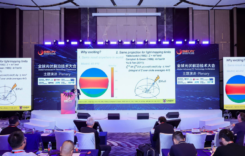

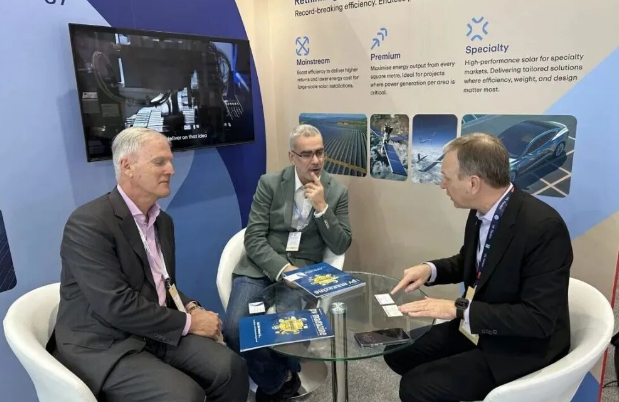
PVTIME – Oxford PV, a leading perovskite solar firm, plans to mass-produce perovskite/silicon tandem modules by 2028 as the reliability and photoelectric conversion efficiency of these modules improves. At the Abu Dhabi World Future Energy Summit (WFES), CEO David Ward unveiled the firm’s technical roadmap and commercialisation blueprint, which is centred on clear efficiency and lifespan goals.
Oxford PV aims to increase module efficiency by 1% each year until 2032, with intermediate targets set at regular intervals. Current efficiency stands at 24%, and is set to reach 25% by 2026 with a 10-year lifespan, 26% with a 15-year lifespan by 2027, and 27% with a 20-year lifespan by 2028. Ward emphasised that a 20-year lifespan is essential for commercialisation, as developers prioritise LCOE. The economic advantage stems from higher generation offsetting initial premiums.
Oxford PV is expanding its global production footprint beyond its facility in Brandenburg, Germany, which produces pilot products for a variety of markets. The company is scouting new factory sites across the Middle East, the US and Europe, with the aim of starting production by late 2027 or early 2028.
For China, the firm uses an asset-light collaboration model. Having entered the market via an exclusive patent licence with Trina Solar in April 2025, it will not build local factories, instead leaving manufacturing and marketing to Trina Solar and its sub-licensees.
Oxford PV specialises in tandem cells rather than single-junction perovskite cells and therefore requires the procurement of an external silicon substrate cell. The company maintains a neutral, open stance on TOPCon and HJT technologies, initially leaning towards HJT for internal experience, but facing no major barriers to switching to TOPCon at a later stage.
Ward noted that more test plant data will be released this year to boost investor and stakeholder confidence. He expects 2026 to see customer development and increased public licensing activity, alongside growing industry interest in perovskite tandem cells.
Regarding pricing, Ward dismissed concerns about new technology premiums, emphasising the importance of reducing LCOE. Perovskite costs are modest, involving few materials and no costly processes, whereas silicon cells remain the largest cost component of tandem modules.
Oxford PV began developing tandem modules in 2014, launched its first large-format model with an efficiency of 26.9% in June 2024, and announced a commercial rollout in the US months later.

Scan the QR code to follow PVTIME official account on Wechat for latest news on PV+ES