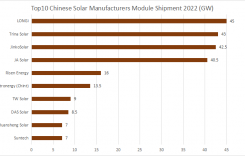

PVTIME – Cumulative module shipments and annualised production capacity offer a robust lens to assess the long-term delivery track record and supply flexibility of solar manufacturers, amid prolonged intense competition across the global photovoltaic supply chain. The comparison dataset reveals a well-defined tiered market structure, with clear gaps in shipment volumes between groups and divergent strategic priorities for capacity expansion.

JinkoSolar leads the sampled peer group, with cumulative module shipments exceeding 420GW and an annualised capacity of 100GW. LONGi follows closely, recording cumulative shipments of 396.35GW while operating the largest annualised capacity within this cohort at 120GW. JA Solar and Trina Solar complete the top tier, with cumulative shipments of 356.38GW and approximately 352GW respectively, paired with annualised capacity of 88GW and 100GW. These four firms have anchored global module supply for years. Their sustained shipment volumes have built substantial barriers in customer networks, project execution experience and supply chain resilience, creating buffers against sharp industry cyclical swings. Competition at this tier has moved beyond short-term quarterly shipment rankings, with long-term delivery credibility now a core differentiator for utility and international buyers.
The second tier covers players with cumulative shipments ranging from roughly 140GW to 180GW, including Canadian Solar, Astronergy (CHINT) and Tongwei Solar. Canadian Solar reports cumulative shipments of 180GW, yet has adopted a distinct disclosure strategy. The firm no longer publishes its worldwide module capacity figure, only outlining its Texas manufacturing base with a planned capacity band of 5–10GW. This shift reflects a broader strategic tilt towards regionally localised production, responding to evolving cross-border trade frameworks. Astronergy holds cumulative shipments above 177.5GW and an annualised capacity of 55GW. Tongwei Solar stands out as a vertically integrated entrant from upstream segments, with cumulative shipments of 141.08GW and annualised module capacity of 85GW, supported by its in-house silicon and cell supply chain.
A third, more diverse group makes up the remainder of the table. This cluster comprises Risen Energy, Yingli Solar, GCL SI, DMEGC, DAS Solar, TCL Zhonghuan, Suntech and Econess, with cumulative shipments falling from 121.4GW down to 47GW. Yingli and Suntech are established pioneers of the solar sector, though their current capacity footprint is far smaller than that of leading manufacturers. TCL Zhonghuan remains primarily a silicon wafer supplier, with module activity as a secondary line; its module shipments sit at around 55.4GW alongside 12GW of annualised capacity. Econess closes the sample set with cumulative shipments of 47GW and 12GW annualised capacity. Businesses within this tier pursue varied routes to market, often focusing on niche segments, regional demand or internal group supply arrangements amid pressure from dominant large-scale suppliers.
It is important to note that cumulative shipments do not correlate linearly with annualised capacity. LONGi operates the highest capacity in this dataset, yet its cumulative shipment total sits marginally below JinkoSolar. Many operators are taking a restrained approach to capacity activation, prioritising stable utilisation rates and order quality to mitigate inventory risks in a supply-heavy market environment. Canadian Solar’s decision to withhold global capacity figures and highlight only its US facilities signals a wider industry shift, where regional manufacturing footprint carries greater commercial relevance than aggregate global capacity.
Market concentration remains pronounced, with the top four manufacturers holding a substantial lead in cumulative delivery volumes. That said, opportunities persist for lower-tier participants via targeted regional distribution, integrated upstream links and differentiated product portfolios. A wider pool of smaller module makers, not featured in this comparison table, rarely publish verified cumulative shipment statistics. These smaller operators generally serve custom and contract manufacturing niches and face acute margin pressure during periods of price compression. For procurement teams and investors, combining long-term cumulative shipment track records with annualised capacity provides a fuller view of operational robustness, rather than relying solely on half-year shipment snapshots.